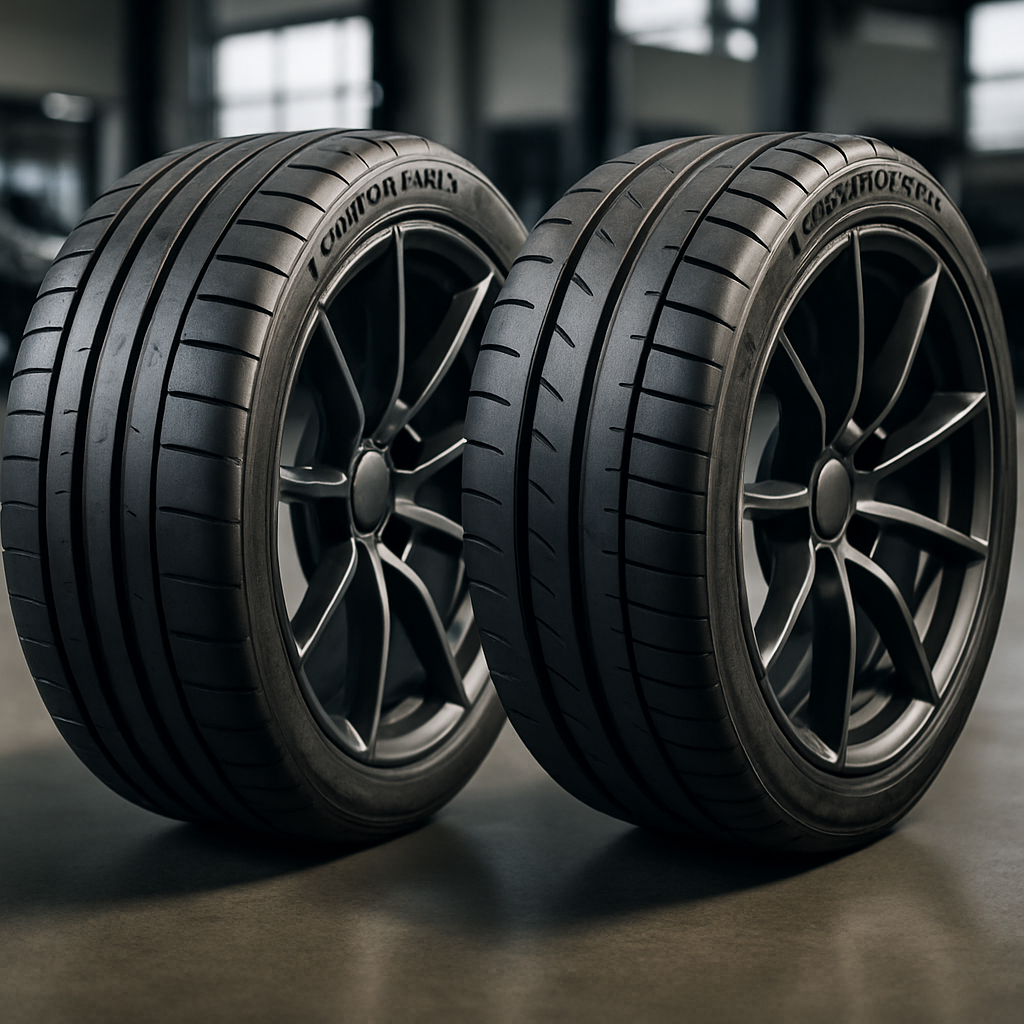
When choosing between the Continental SportContact 7 and Michelin Pilot Sport 4S, both represent the pinnacle of ultra-high-performance summer tyres engineered for sports cars and performance-oriented vehicles. The SportContact 7 delivers sharper steering response and excels in dry conditions with improved lap times, whilst the Pilot Sport 4S offers superior wet weather grip and longer tread life. For track-focused driving, the Continental edges ahead; for balanced year-round summer performance with exceptional comfort, the Michelin proves the more versatile choice. Both tyres require careful consideration of your driving style, vehicle specifications, and priority between outright speed versus all-round capability.
Quick comparison table
| Attribute | Continental SportContact 7 | Michelin Pilot Sport 4S |
|---|---|---|
| Price range | £150-£400 per tyre | £140-£380 per tyre |
| Dry grip performance | Exceptional (9.5/10) | Excellent (9/10) |
| Wet grip performance | Excellent (8.5/10) | Exceptional (9.5/10) |
| Tread wear durability | 20,000-25,000 miles | 25,000-30,000 miles |
| Noise level | 71-73 dB | 69-71 dB |
| Comfort rating | Good (7.5/10) | Very good (8.5/10) |
| Best use case | Track days & spirited driving | Daily performance & wet roads |
Product overview: Continental SportContact 7
The Continental SportContact 7 represents German engineering at its finest, designed specifically for drivers who demand maximum performance from their sports cars, hot hatches, and high-powered saloons. This tyre utilises Continental’s Black Chili compound technology, which incorporates specially developed polymers and filler materials that enhance grip levels without sacrificing structural integrity during high-speed cornering.
The asymmetric tread pattern features larger outer shoulder blocks that increase contact patch area during aggressive cornering, whilst the central rib design maintains straight-line stability at motorway speeds. Continental engineers integrated adaptive tread blocks that adjust their stiffness depending on load transfer, delivering predictable handling characteristics whether you’re navigating tight corners or accelerating hard out of bends.
Typical pricing ranges from £150 for smaller 18-inch fitments to approximately £400 for larger 21-inch applications, positioning it competitively within the ultra-high-performance segment. The SportContact 7 suits vehicles ranging from Porsche 911s and BMW M-series to Audi RS models and performance-oriented Volkswagens.
Advantages:
- Outstanding dry-weather lateral grip, particularly during high-speed cornering
- Extremely responsive steering feedback with minimal delay
- Reduced braking distances on dry surfaces compared to previous generation
- Excellent heat dissipation during track use, maintaining consistency over multiple laps
- Progressive breakaway characteristics that warn skilled drivers before limit
Disadvantages:
- Slightly reduced tread life compared to competitors, especially under aggressive driving
- Noticeably firmer ride quality on uneven road surfaces
- Higher road noise levels at cruising speeds
- Performance drops more significantly in temperatures below 7°C
- Premium pricing for larger diameter fitments
Ideal drivers: Enthusiasts who regularly attend track days, drivers prioritising outright performance over comfort, owners of high-powered rear-wheel-drive sports cars, and those living in regions with predominantly dry summer conditions.
“Our technical team at AutoPartsPro has observed that the SportContact 7 truly excels when fitted to vehicles with adaptive damping systems. The tyre’s stiff sidewall construction works brilliantly with electronically controlled suspension, allowing drivers to exploit its full potential without compromising daily usability.”
Product overview: Michelin Pilot Sport 4S
The Michelin Pilot Sport 4S employs a hybrid construction philosophy that combines different rubber compounds for the inner and outer tread sections. The outer shoulder uses a track-focused elastomer blend optimised for dry grip, whilst the inner section features a functional elastic polymer specifically engineered to disperse water efficiently and maintain contact in wet conditions.
This French manufacturer incorporates their Dynamic Response Technology, which includes aramid and nylon reinforcements within the casing structure. These materials, commonly found in aerospace applications, provide exceptional stability at high speeds whilst allowing the tread to conform to road irregularities, improving both comfort and grip.
Pricing typically spans £140 to £380 depending on diameter and width specifications, offering slight cost advantages over the Continental in certain sizes. The Pilot Sport 4S achieves remarkable versatility, suiting everything from Mercedes-AMG models and Jaguar F-Types to Tesla Model 3 Performance variants and even certain SUVs like the Porsche Macan Turbo.
Advantages:
- Class-leading wet-weather performance with exceptional hydroplaning resistance
- Superior tread longevity, often achieving 25-30% more miles than competitors
- Quieter operation with reduced cabin noise intrusion
- More compliant sidewalls providing better comfort without sacrificing handling precision
- Consistent performance across wider temperature ranges
Disadvantages:
- Marginally less immediate steering response compared to the SportContact 7
- Slightly longer dry braking distances from very high speeds
- Ultimate dry grip limit reached fractionally sooner during track sessions
- Less communicative at the absolute limit of adhesion
- Limited availability in certain less common sizing specifications
Ideal drivers: Performance car owners seeking year-round summer tyre capability, drivers covering high annual mileage, those prioritising wet-weather safety, and enthusiasts wanting balanced performance without track-focused compromises.
“After extensive testing on British roads, our specialists consistently recommend the Pilot Sport 4S to customers who experience frequent rain and variable conditions. Its ability to maintain predictable handling when encountering sudden downpours makes it particularly suitable for UK driving patterns, where weather can change dramatically within minutes.”
Compatibility considerations for performance tyres
Both the SportContact 7 and Pilot Sport 4S are available in comprehensive size ranges spanning 17 to 22-inch diameters, with widths from 205mm through to 325mm. However, proper fitment verification remains critical for optimal performance and safety.
Check your vehicle’s handbook or the placard typically located on the driver’s door pillar for manufacturer-recommended tyre specifications. These details include diameter, width, aspect ratio, load index, and speed rating. Performance tyres must meet or exceed these specifications, particularly the load and speed ratings.
For vehicles manufactured from 2014 onwards, ensure any replacement tyres maintain the same speed rating as original equipment. Many modern performance vehicles feature staggered fitments, with wider tyres on the rear axle. Always replace tyres in axle pairs to maintain balanced handling characteristics.
Model year considerations become particularly important for vehicles receiving mid-cycle updates. A 2018 BMW M3 might accept different sizes compared to a 2020 model following a facelift. Consult OEM specifications or specialist tyre retailers to confirm correct applications.
Installation notes vary depending on your vehicle’s systems. Cars equipped with tyre pressure monitoring systems (TPMS) require sensor recalibration after fitment. Performance vehicles with adaptive suspension may need electronic recoding to optimise damper response for the new tyre’s characteristics. Always inform your fitter about such systems before installation begins.
Both manufacturers recommend professional fitting by trained technicians using calibrated torque wrenches for wheel bolts. Incorrect installation torque can lead to wheel damage or, in extreme cases, detachment whilst driving.
Final verdict and buying recommendation
Your choice between these exceptional tyres ultimately depends on how you use your vehicle and what aspects of performance matter most.
Choose the Continental SportContact 7 if you:
- Regularly participate in track days or spirited driving events
- Prioritise the sharpest possible steering response and feedback
- Drive primarily in dry conditions or live in regions with minimal rainfall
- Own a rear-wheel-drive sports car optimised for handling precision
- Value outright performance over comfort and longevity
Choose the Michelin Pilot Sport 4S if you:
- Need reliable wet-weather capability for unpredictable British climate
- Cover substantial annual mileage and value tread longevity
- Want balanced performance suitable for both daily driving and occasional spirited runs
- Prefer quieter cabin environment during motorway journeys
- Drive a powerful all-wheel-drive vehicle or grand tourer
Both tyres deliver performance levels that exceed what most drivers will regularly exploit on public roads. For pure track enthusiasts, the Continental offers measurable advantages. For the majority seeking exceptional capability with greater everyday versatility, the Michelin presents the more rounded package.
Consider pairing either tyre choice with proper wheel alignment to maximise their potential. Regular checks of wheel bearings and suspension components ensure these high-performance tyres work as intended. Neither tyre will compensate for worn suspension arms or degraded shock absorbers.
Frequently asked questions
Can I mix Continental SportContact 7 and Michelin Pilot Sport 4S on the same vehicle?
Mixing different tyre models across axles is strongly discouraged and potentially dangerous. Different tread compounds and construction methods create unpredictable handling characteristics, particularly during emergency manoeuvres. Always fit matching tyres to both wheels on each axle for consistent performance and safety.
How long do these ultra-high-performance tyres typically last?
Expect 20,000-25,000 miles from the SportContact 7 under mixed driving conditions, whilst the Pilot Sport 4S typically delivers 25,000-30,000 miles. Aggressive driving, improper inflation, and misaligned suspension significantly reduce these figures. Track use accelerates wear dramatically on both models.
Are these tyres suitable for light winter use?
Neither tyre is appropriate for winter conditions. Both use summer compounds that harden below 7°C, substantially reducing grip on cold or icy surfaces. Invest in dedicated winter tyres or all-season alternatives for cold-weather months to maintain safety standards.
Do these tyres require special maintenance or running-in procedures?
Both manufacturers recommend a 100-mile running-in period, avoiding maximum acceleration, hard braking, and aggressive cornering. This allows release agents from the manufacturing process to wear away and permits the tread to achieve optimal surface characteristics. Regular pressure checks every fortnight maintain performance and longevity.
Will fitting these tyres improve my car’s performance noticeably?
Upgrading from budget or mid-range tyres delivers immediately noticeable improvements in grip, steering precision, and braking performance. However, replacing equivalent premium performance tyres yields subtler differences that become apparent primarily during enthusiastic driving or track use. The improvement magnitude depends heavily on your previous tyre specification.