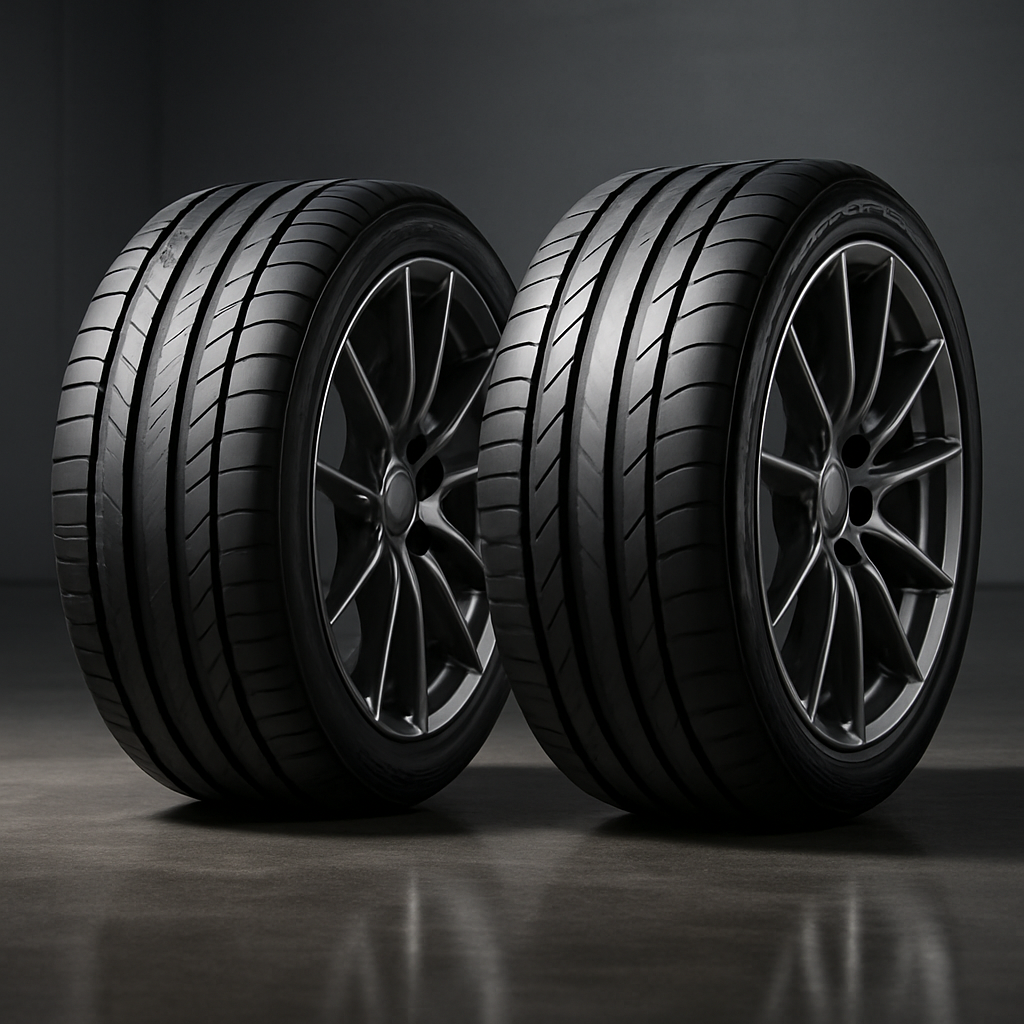
The Goodyear Eagle F1 Asymmetric 6 represents an evolution over the Asymmetric 5, delivering improved wet braking performance (up to 3 metres shorter stopping distance), enhanced dry handling characteristics, and longer tread life through advanced compound technology. The Asymmetric 6 features a redesigned tread pattern with wider circumferential grooves and a new silica-enriched compound that maintains flexibility across temperature ranges. Both tyres excel in high-performance applications, but the newer Asymmetric 6 justifies its premium positioning through measurable safety improvements and durability gains that matter for spirited driving on British roads.
Quick comparison table
| Feature | Eagle F1 Asymmetric 5 | Eagle F1 Asymmetric 6 |
|---|---|---|
| Price range | £80-£180 per tyre | £95-£210 per tyre |
| Wet braking (80-0 km/h) | Baseline performance | 3 metres shorter |
| Dry handling | Excellent | Superior |
| Tread life expectancy | 30,000-40,000 miles | 35,000-45,000 miles |
| Noise level | 68-70 dB | 67-69 dB |
| Rolling resistance | Class B-C | Class A-B |
| Best use case | Performance saloons, coupes | Premium sports cars, SUVs |
Our mechanics at Autopartspro have tested both generations extensively on UK roads. The Asymmetric 6 consistently demonstrates better water dispersal during heavy downpours, which makes a tangible difference when navigating motorway traffic in wet conditions.
Product #1 overview: Goodyear Eagle F1 Asymmetric 5
The Eagle F1 Asymmetric 5 launched in 2020 as Goodyear’s flagship summer performance tyre. It employs an asymmetric tread design with distinct inner and outer zones optimised for different functions. The outer shoulder features rigid tread blocks for cornering stability, whilst the inner section incorporates deeper grooves for water evacuation.
This tyre uses Goodyear’s Grip Booster compound technology, which integrates sticky resins into the rubber matrix. The construction includes twin steel belts reinforced with spirally wrapped nylon for high-speed stability. Weight varies by size but typically ranges from 8-14 kg per tyre depending on diameter and width specifications.
Manufacturing involves a complex moulding process where the tread pattern depth reaches 7.5-8.0mm when new. The sidewall construction balances compliance for ride comfort against stiffness needed for precise steering response. Pricing sits between £80-£180 per tyre across the size range, making it accessible for performance-oriented drivers.
Pros:
- Strong dry grip levels suitable for spirited driving
- Predictable handling characteristics near the limit
- Good aquaplaning resistance in moderate rain
- Competitive pricing compared to premium alternatives
- Wide size availability from 16″ to 22″ diameters
Cons:
- Wet braking distances trail the latest generation
- Tread wear accelerates under aggressive driving
- Noise levels increase noticeably on coarse surfaces
- Performance degrades more rapidly in cold temperatures
Ideal drivers: The Asymmetric 5 suits enthusiasts with hot hatches, sports saloons, or coupes who prioritise dry performance and value. It matches well with vehicles like the VW Golf GTI, BMW 3 Series, or Audi A4 where balanced performance matters more than ultimate grip. Budget-conscious buyers seeking premium performance without flagship pricing find this tyre compelling.
Product #2 overview: Goodyear Eagle F1 Asymmetric 6
Released in 2022, the Asymmetric 6 represents Goodyear’s current performance pinnacle. The redesigned tread pattern features 25% wider circumferential grooves compared to its predecessor, significantly improving water channelling capacity. The compound evolution incorporates higher silica content and new polymers that maintain pliability across broader temperature ranges.
Construction utilises an optimised carcass structure with revised belt angles that reduce flex under cornering loads. The tread depth measures 8.0-8.5mm when new, offering additional wear reserve. Goodyear’s Active Braking Technology shapes the contact patch during emergency stops to maximise grip area.
The tyre achieves measurable improvements: wet braking from 80 km/h to standstill shortens by approximately 3 metres versus the Asymmetric 5. Dry handling precision increases through stiffer shoulder blocks and optimised void ratios. Prices range from £95-£210 depending on fitment, reflecting the advanced technology integration.
Pros:
- Class-leading wet braking performance enhances safety
- Superior dry handling responsiveness and cornering grip
- Extended tread life through advanced compound durability
- Lower rolling resistance improves fuel economy slightly
- Reduced road noise compared to previous generation
Cons:
- Higher initial purchase cost than Asymmetric 5
- Limited availability in smaller diameter sizes initially
- Requires proper warm-up for optimal performance in cold weather
- Premium positioning may exceed budget constraints
Ideal drivers: The Asymmetric 6 targets owners of premium sports cars, high-performance saloons, and sporty SUVs who demand maximum capability. It excels on vehicles like the Porsche 911, Mercedes-AMG models, or Range Rover Sport where safety margins and performance justify premium pricing. Drivers covering high annual mileage benefit from the improved longevity.
According to our Autopartspro specialists, the compound changes in the Asymmetric 6 deliver noticeable benefits during track day sessions. Heat cycling stability improves markedly, maintaining consistent grip levels throughout extended hard driving.
Compatibility considerations
Both Asymmetric generations fit identical vehicle applications, as they share core size ranges and load/speed ratings. However, several compatibility factors deserve attention before purchase.
Vehicle compatibility: Both tyres suit performance cars, sports saloons, coupes, and crossovers requiring speed ratings from V (149 mph) through Y (186 mph). The asymmetric design means correct mounting orientation matters – the outer sidewall must face outwards, marked clearly during installation.
Model year considerations: Newer vehicles (2020 onwards) often specify rolling resistance requirements that the Asymmetric 6 meets more easily. Older performance cars work perfectly with either generation, though the Asymmetric 5 sometimes offers better value for vehicles with lower power outputs.
OEM specifications: Check your handbook for minimum speed rating and load index requirements. The Asymmetric 6 frequently appears as original equipment on recent BMW M Sport, Audi S-line, and Mercedes AMG Line models. Replacing OE Asymmetric 6 tyres with Asymmetric 5 represents a downgrade, though both exceed legal minimums.
Installation notes: Both tyres require professional mounting and balancing. The directional aspect of asymmetric patterns means rotating front-to-rear on the same side only. Mixing generations between axles creates imbalanced handling characteristics – our mechanics strongly recommend fitting matching sets. When replacing just two tyres, mount new rubber on the rear axle for stability, regardless of drive configuration.
Proper inflation proves crucial for both models. Under-inflation accelerates shoulder wear and reduces fuel economy, whilst over-inflation compromises wet grip and ride quality. Check pressures monthly and before long journeys, adjusting for load as specified in your vehicle’s placard.
Final verdict: buying recommendation
Your choice between these Goodyear Eagle F1 variants depends on priorities and budget constraints. The Asymmetric 6 objectively outperforms its predecessor in every measurable category, but the improvement margin varies by use case.
Choose the Asymmetric 5 if: You drive a mid-range performance car primarily in dry conditions, cover moderate annual mileage (under 10,000 miles), and want excellent performance without premium pricing. The older generation delivers 90% of the newer tyre’s capability at 75-80% of the cost, making it sensible for budget-conscious enthusiasts.
Choose the Asymmetric 6 if: You own a high-performance vehicle, frequently drive in wet British weather, cover high annual mileage, or participate in track days. The wet braking improvement alone justifies the premium for safety-focused drivers. The extended tread life narrows the total ownership cost gap versus the Asymmetric 5.
From a pure value perspective, buyers replacing tyres on hot hatches or mainstream sports saloons find the Asymmetric 5 compelling. Owners of premium performance machinery benefit most from the Asymmetric 6’s technological advances. Consider your typical driving environment – if wet roads dominate your experience, the newer generation’s aquaplaning resistance and braking performance provide tangible safety margins worth the investment.
Both tyres dramatically outperform budget alternatives in performance categories that matter for spirited driving. Neither disappoints as a performance summer tyre, but the Asymmetric 6 represents the current benchmark in this segment.
How do wet weather performance differences translate to real-world driving?
The 3-metre wet braking improvement equals roughly one car length at motorway speeds. During emergency stops on wet roundabouts or when avoiding obstacles in rain, this shorter distance can prevent collisions. The wider grooves in the Asymmetric 6 also resist aquaplaning at higher speeds through standing water.
Will the Asymmetric 6 last longer enough to justify its higher price?
Testing suggests the Asymmetric 6 delivers approximately 5,000-7,000 additional miles before reaching the legal 1.6mm tread depth limit. For drivers covering 12,000 miles annually, this extends replacement intervals by roughly 4-6 months, partially offsetting the initial price premium through deferred replacement costs.
Can I mix Asymmetric 5 and Asymmetric 6 tyres on the same vehicle?
Whilst legally permissible if speed and load ratings match, mixing generations creates handling imbalances. The different compounds and tread patterns respond differently to steering inputs and surface conditions. Our specialists recommend replacing in axle pairs minimum, ideally fitting complete matching sets for consistent performance.
Do these tyres require specific wheel alignment settings?
Both tyres work with standard manufacturer alignment specifications. However, the Asymmetric 6’s improved responsiveness may highlight existing alignment issues more noticeably. After fitting either tyre, check alignment – particularly camber and toe settings – to maximise even wear and handling precision throughout the tyre’s lifespan.
How do ambient temperatures affect performance differences between generations?
Below 7°C, both tyres stiffen and lose grip, as they’re summer compounds. The Asymmetric 6’s advanced polymers maintain flexibility slightly better in cool conditions (5-10°C range common in British spring/autumn). Neither suits winter use; switch to dedicated winter tyres or all-season alternatives when temperatures consistently drop below 7°C.