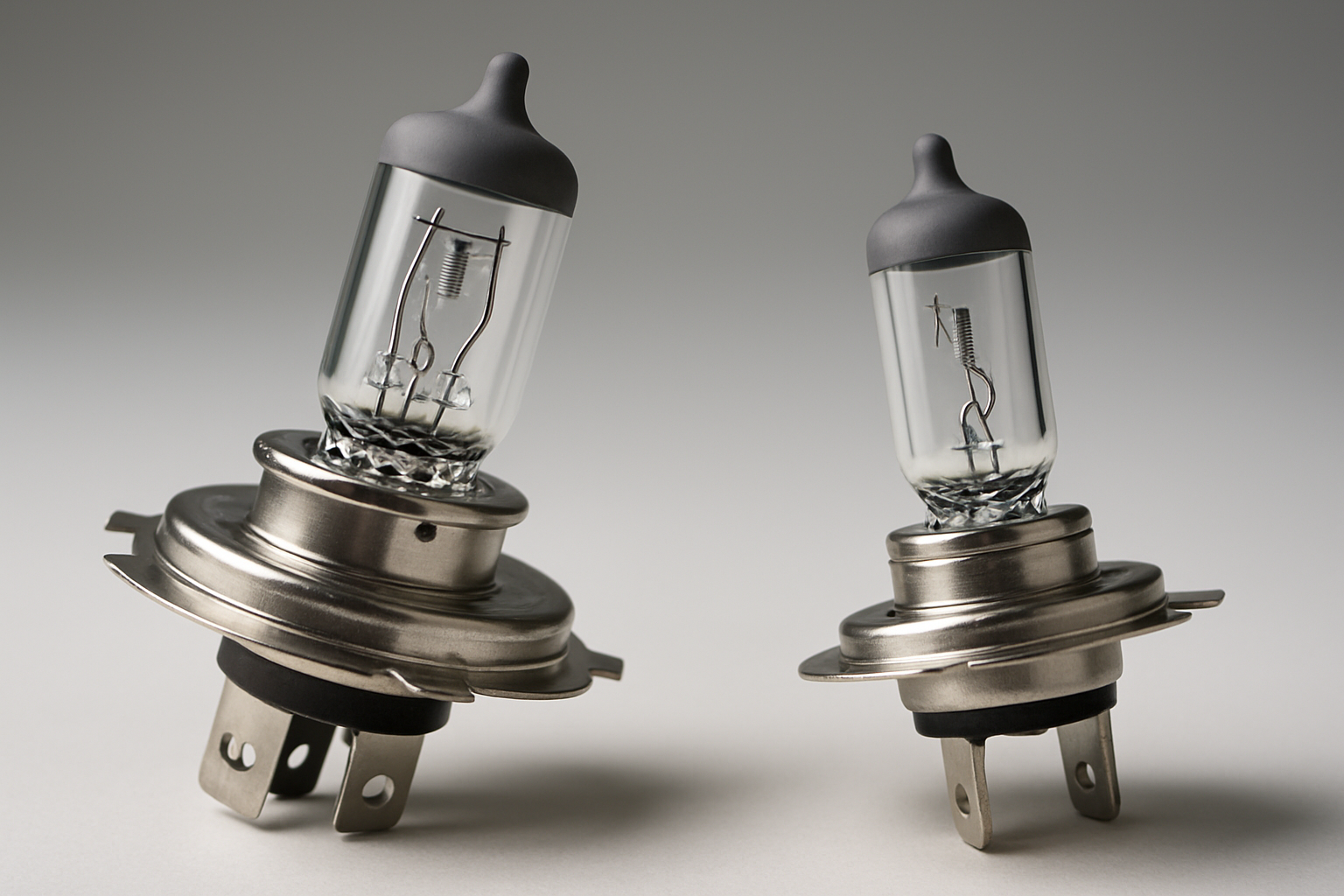
When choosing between H4 and H7 bulbs for your vehicle, the fundamental difference lies in their filament configuration and beam pattern capabilities. H4 bulbs feature a dual-filament design that handles both dipped and main beam functions from a single unit, whilst H7 bulbs contain a single filament and require separate bulbs for each lighting function. This distinction affects everything from installation complexity to replacement costs, making it essential for UK motorists to understand which type suits their vehicle and driving needs best.
Quick comparison table
| Feature | H4 Bulb | H7 Bulb |
|---|---|---|
| Filament configuration | Dual filament (dipped and main beam) | Single filament (one function only) |
| Typical price range | £8-£35 per bulb | £6-£30 per bulb |
| Light output | 60/55W (main/dipped) | 55W |
| Installation complexity | Single unit replacement | Requires two bulbs per headlamp |
| Beam pattern quality | Good, but combined design | Excellent, optimised per function |
| Replacement frequency | Replace when either beam fails | Replace individual beam bulbs |
| Best use case | Older vehicles, cost-effective dual beam | Modern vehicles requiring superior beam control |
Product #1 overview: H4 bulbs
H4 bulbs represent a traditional halogen lighting solution that has served motorists reliably for decades. The design incorporates two tungsten filaments within a single glass envelope, with one producing the dipped beam and the other the main beam. This dual-filament architecture uses a three-pin connector configuration that supplies power to the appropriate filament based on your lighting selection.
The construction involves a precise filament positioning system where the dipped beam filament sits slightly forward with a shield to prevent glare, whilst the main beam filament occupies the focal point of the reflector. Most H4 units produce 60 watts for main beam and 55 watts for dipped beam, generating approximately 1650 and 1000 lumens respectively.
Materials used in quality H4 bulbs include quartz glass for the envelope, which withstands higher temperatures than standard glass, and a halogen gas fill containing iodine or bromine. The filament itself comprises tungsten wire wound in a specific coil pattern to maximise light output whilst maintaining longevity.
Pricing for H4 bulbs varies considerably based on specification. Standard replacement units cost between £8-£15, whilst premium options with enhanced brightness or extended lifespan range from £20-£35 per bulb. Performance variants claiming up to 130% more light can reach £40.
Pros of H4 bulbs
- Single bulb handles both beam functions, reducing replacement complexity
- Widely available across automotive retailers throughout the UK
- Simple installation process suitable for home mechanics
- Cost-effective solution for older vehicle models
- Proven reliability with decades of development
Cons of H4 bulbs
- Beam pattern quality compromised by dual-function design
- Both beams lost if single filament fails
- Less precise light distribution than dedicated single-beam systems
- Limited upgrade potential compared to modern systems
- Higher heat generation within single envelope
Ideal drivers for H4 bulbs
H4 bulbs suit motorists operating older vehicles designed before the widespread adoption of separate beam systems. They’re particularly appropriate for classic car enthusiasts maintaining period-correct specifications, budget-conscious drivers needing reliable illumination without premium costs, and rural drivers with simpler vehicles where sophisticated beam patterns aren’t critical. Owners of motorcycles also frequently encounter H4 fitments.
Product #2 overview: H7 bulbs
H7 bulbs embody modern automotive lighting philosophy, using a single-filament design that allows each headlamp function to have its own optimised bulb. This configuration emerged in the 1990s as manufacturers sought improved beam control and safety performance. The single filament can be positioned precisely at the reflector’s focal point, producing sharper cut-off lines and better light distribution.
The physical construction features a PX26d base fitting with two metal contacts and a positioning lug ensuring correct installation. The filament sits within a compact quartz glass capsule filled with halogen gas under pressure. This pressurised environment allows the tungsten filament to operate at higher temperatures, producing whiter, brighter light than older H4 technology.
Quality H7 units employ advanced materials including UV-blocking quartz glass that protects the headlamp’s reflector coating from degradation. The filament wire uses precise winding techniques to create an arc discharge-like point source, maximising the efficiency of modern projector-style headlamp optics. Some premium variants incorporate blue-tinted glass to filter the light spectrum towards cooler colour temperatures.
Standard H7 bulbs retail between £6-£12 each, with premium offerings ranging from £15-£30. Remember that your vehicle requires separate H7 bulbs for dipped and main beams, effectively doubling the purchase cost compared to H4 systems. Performance-enhanced variants promising 150% more light can exceed £35 per bulb.
Pros of H7 bulbs
- Superior beam pattern with precise cut-off definition
- Optimised light distribution for each function
- Individual bulb failure doesn’t eliminate all lighting
- Better compatibility with modern projector headlamps
- Wider range of performance upgrades available
- Cooler colour temperature options for improved visibility
Cons of H7 bulbs
- Requires purchasing two bulbs per headlamp assembly
- More complex replacement procedure in some vehicles
- Higher total system cost for complete replacement
- Some installations require removing components for access
- Mixing old and new bulbs creates uneven lighting
Ideal drivers for H7 bulbs
H7 bulbs excel for drivers of modern vehicles manufactured from the late 1990s onwards, particularly those with projector-style headlamps. They’re essential for motorists prioritising safety through superior beam definition, especially those who frequently drive on unlit roads where precise dipped beam cut-off prevents dazzling oncoming traffic whilst maximising road illumination. Performance car owners appreciate the upgrade potential, whilst company car drivers maintaining fleet vehicles benefit from the widespread standardisation.
Our workshop specialists at AutoPartsPro consistently observe that H7 systems demonstrate superior beam geometry in projector housings. The single-filament design allows manufacturers to position the light source with millimetre precision, resulting in sharper cut-off lines that improve safety for both the driver and oncoming traffic.
Compatibility (very important for parts ecommerce)
Determining whether your vehicle requires H4 or H7 bulbs is straightforward but critical. Check your owner’s handbook, which specifies bulb types for all lighting positions. Alternatively, remove an existing bulb and examine the base markings – both H4 and H7 bulbs have their designation clearly stamped on the metal base.
Vehicle compatibility typically follows manufacturing periods. Most cars produced before 1995 use H4 bulbs, whilst those from 1997 onwards predominantly specify H7 units. However, exceptions exist, particularly in budget models that retained H4 systems longer, and premium marques that adopted H7 technology earlier.
Model year considerations matter significantly. Facelifted versions of the same model sometimes switch bulb types. For instance, pre-facelift Volkswagen Golfs Mk4 used H4 bulbs, whilst later versions switched to H7. Always verify using your specific vehicle’s registration number when ordering headlamp components.
OEM specifications
Original equipment manufacturer specifications determine which bulb type your vehicle’s headlamp reflector or projector lens was designed to accommodate. The reflector shape, size and coating are engineered specifically for either H4’s dual-filament positioning or H7’s single-filament focal point. Using the wrong type produces poor beam patterns, potentially failing MOT tests and creating road safety hazards.
Some vehicles use H7 bulbs for dipped beam but different types for main beam – H1 bulbs are common in this application. Always check both functions separately. European regulations mandate specific beam patterns that depend on correct bulb fitment, making OEM compliance essential.
Installation notes
H4 installation involves disconnecting the three-pin connector, releasing the wire retaining clip or twist-lock collar, and withdrawing the bulb. Handle new bulbs only by the base – skin oils on the glass envelope cause hotspots that dramatically shorten lifespan. The process typically takes 5-10 minutes per headlamp.
H7 replacement can be more involved. Many vehicles require removing the headlamp unit or accessing through the wheel arch. The two-pin connector pulls straight off, but the spring clip securing the bulb requires careful manipulation. Some installations demand small hands or specific tool access. Budget 15-30 minutes per bulb for first attempts.
Both types benefit from replacing bulbs in pairs. Even if only one has failed, the remaining bulb has experienced similar operating hours and will likely fail soon. Mismatched bulbs also create uneven lighting intensity and colour temperature. When working with automotive bulbs, ensure the ignition is off and allow cooling time if the vehicle was recently operated.
From our technical experience, we advise motorists to keep spare bulbs in the vehicle. Continental European countries like France require this by law, and whilst the UK doesn’t mandate it, having spares prevents being stranded with failed lighting. H7’s individual beam bulbs mean you’ll still have some illumination if one fails, unlike H4 where filament failure can eliminate both beams.
Final verdict (buying recommendation)
Your bulb choice isn’t actually a choice – it’s determined by your vehicle’s headlamp design. You must use whichever type your manufacturer specified. However, understanding the differences helps you make informed decisions about quality levels and upgrade options within your designated type.
For H4 users, invest in quality branded bulbs rather than budget alternatives. The dual-filament design already compromises beam quality compared to H7 systems, so maximising bulb quality helps offset this limitation. Premium H4 bulbs with enhanced brightness coatings deliver noticeably better illumination during night driving and adverse weather.
For H7 users, the superior baseline performance means standard bulbs often suffice for typical driving. However, if you frequently drive unlit rural roads or motorways, premium H7 bulbs with increased light output provide meaningful safety benefits. The crisper beam pattern of H7 systems maximises the effectiveness of brightness upgrades.
Consider LED or HID conversion kits only if your vehicle has projector headlamps and you’re prepared to invest in quality units with proper beam patterns. Cheap conversions create glare that endangers other road users and typically fail MOT tests. Stick with quality halogen bulbs for reflector-style housings.
Choose standard brightness bulbs for urban driving where street lighting supplements your headlamps. Opt for enhanced brightness variants (advertised as +50%, +100%, +130%) for rural routes and motorway use. For vehicles requiring multiple H7 bulbs, budget approximately £40-£80 for a complete premium replacement set covering all beam functions.
Frequently asked questions
Can I use H7 bulbs in H4 sockets or vice versa?
No, H4 and H7 bulbs are not interchangeable. They have completely different base configurations – H4 uses a three-pin P43t base whilst H7 uses a two-pin PX26d base. The physical fittings won’t match, and the electrical requirements differ. Always use the bulb type specified for your vehicle’s headlamp assembly.
Which bulb type produces brighter light output?
H7 bulbs generally produce more effective illumination due to superior beam focus rather than raw output. Whilst H4 main beams produce 60W versus H7’s 55W, the H7’s single-filament design positions light more precisely at the reflector focal point, creating better road coverage and visibility without increased glare to oncoming traffic.
How long do H4 versus H7 bulbs typically last?
Standard halogen bulbs of both types last approximately 400-1000 hours depending on quality and usage patterns. H4 bulbs may fail more frequently in dual-filament systems because heat from one filament affects the other. Premium long-life variants of either type can exceed 2000 hours, though often with reduced brightness output.
Do H4 or H7 bulbs work better with projector headlamps?
H7 bulbs significantly outperform H4 in projector housings. Projector optics require precise point-source illumination that single-filament H7 bulbs provide. The dual filaments in H4 bulbs cannot both occupy the optimal focal point, resulting in compromised beam sharpness and reduced effectiveness with projector lens systems designed for H7 specification.
Are premium bulbs worth the extra cost for either type?
Premium bulbs offering enhanced brightness (typically 30-50% more light) provide worthwhile improvements for drivers frequently using unlit roads. The upgrade costs £10-20 more per bulb but delivers measurably better visibility. However, extremely high-output variants claiming 100-150% increases often achieve this through reduced lifespan, requiring more frequent replacement that negates cost benefits.