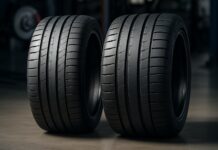
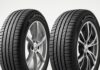
When comparing the Goodyear Eagle F1 Asymmetric 6 vs Continental PremiumContact 7, the key difference lies in their primary focus: the Goodyear Eagle F1 Asymmetric 6 is a high-performance summer tyre designed for sporty driving with exceptional grip and handling, whilst the Continental PremiumContact 7 prioritises comfort, fuel efficiency, and all-round versatility for everyday motoring. The Eagle F1 excels in dry and wet braking with sharper steering response, making it ideal for enthusiasts, whereas the PremiumContact 7 offers quieter rides, longer tread life, and better mileage for family cars and daily commuters.
Quick comparison table
| Feature | Goodyear Eagle F1 Asymmetric 6 | Continental PremiumContact 7 |
|---|---|---|
| Price range | £90 – £200 per tyre | £85 – £190 per tyre |
| Durability | Good (25,000 – 35,000 miles) | Excellent (35,000 – 45,000 miles) |
| Performance | Sporty, high grip, sharp handling | Balanced, comfort-focused, efficient |
| Noise level | Moderate (69-71 dB) | Low (67-69 dB) |
| Maintenance | Standard rotation every 6,000 miles | Standard rotation every 6,000 miles |
| Best use case | Performance cars, enthusiasts | Family saloons, SUVs, daily driving |
Both tyres represent premium offerings from leading manufacturers, but cater to different driving preferences and vehicle types. Understanding these distinctions helps UK motorists make informed decisions based on their specific requirements.
Product #1 overview: Goodyear Eagle F1 Asymmetric 6
The Goodyear Eagle F1 Asymmetric 6 is engineered for drivers who prioritise dynamic handling and sporty performance. This premium tyre features an asymmetric tread pattern with distinct inner and outer zones optimised for different road conditions.
The construction employs advanced silica compounds mixed with resin technology, enhancing grip on both dry and wet surfaces. The tread blocks are designed with chamfered edges and 3D geometry to maintain consistent contact pressure during cornering. The shoulder area uses rigid blocks for precise steering feedback, whilst the centre ribs provide stability at motorway speeds.
How it works
The asymmetric design splits responsibilities: the outer shoulder handles dry cornering forces, the intermediate zone manages water evacuation through wide circumferential grooves, and the inner section provides wet grip through dense siping. The compound remains flexible across a wide temperature range, maintaining performance from cold British mornings to warm summer afternoons.
Materials and construction
Goodyear utilises a dual-compound system with softer rubber on the shoulders for grip and harder material in the centre for longevity. The internal structure features twin steel belts reinforced with spirally wound nylon for high-speed stability. The sidewall construction balances rigidity with compliance for responsive handling without harshness.
Typical price
Expect to pay between £90 for smaller 16-inch fitments to £200 for larger 20-inch sizes. Mid-range 17-18 inch tyres typically cost £110-£150 each, making this a premium investment for performance-oriented vehicles.
Pros
- Outstanding dry grip with short braking distances
- Excellent wet weather performance and aquaplaning resistance
- Sharp, communicative steering response
- High-speed stability up to V and Y ratings
- Impressive cornering grip for spirited driving
Cons
- Higher road noise compared to comfort-oriented tyres
- Shorter tread life than touring alternatives
- Firmer ride quality on rough surfaces
- Premium pricing compared to mid-range options
- Performance focus sacrifices some fuel economy
Ideal drivers
This tyre suits enthusiastic drivers with performance saloons, hot hatches, or sports cars who value handling precision and grip over ultimate comfort. Owners of BMW 3 Series, Audi A4 S-line, Volkswagen Golf GTI, or similar vehicles will appreciate the dynamic characteristics. It’s also suitable for younger drivers with powerful first cars or anyone who regularly enjoys spirited country road driving whilst maintaining safety margins.
Our specialists at AutoPartsPro have observed that the Eagle F1 Asymmetric 6 delivers notably shorter wet braking distances compared to its predecessor, typically saving 2-3 metres from 60 mph—a significant safety advantage on British roads where rain is frequent.
Product #2 overview: Continental PremiumContact 7
The Continental PremiumContact 7 represents a different philosophy, focusing on balanced all-round performance with emphasis on comfort, efficiency, and longevity. This tyre targets the mainstream premium market where refinement matters as much as capability.
Continental employs its proprietary Adaptive Flex Compound which adjusts to road conditions, remaining supple in cold weather whilst resisting wear in warm conditions. The symmetric tread design features a continuous centre rib for straight-line stability and intermediate blocks with chamfered edges to reduce pattern noise.
How it works
The PremiumContact 7 uses a balanced approach with four wide longitudinal grooves for water evacuation and lateral sipes for wet grip. The contact patch geometry is optimised for even pressure distribution, reducing irregular wear and extending tread life. The compound chemistry prioritises low rolling resistance to improve fuel economy without sacrificing grip.
Materials and construction
Continental’s silica-enriched compound provides flexibility for wet grip whilst maintaining structural integrity for dry performance. The casing construction uses twin steel belts with a nylon cap ply for dimensional stability. The sidewall design incorporates comfort-enhancing features that absorb minor road imperfections without compromising handling precision. Additional braking components work in harmony with such tyres for optimal safety.
Typical price
Pricing ranges from £85 for compact car sizes (15-16 inch) to £190 for larger SUV and executive saloon fitments (19-20 inch). Common 17-18 inch sizes cost £100-£145, positioning this tyre competitively within the premium segment whilst offering better value than ultra-high-performance alternatives.
Pros
- Exceptionally quiet and comfortable ride quality
- Extended tread life with even wear patterns
- Low rolling resistance improves fuel efficiency
- Strong wet weather performance and safety
- Versatile across various vehicle types and uses
Cons
- Less sporty handling feedback than performance tyres
- Slightly longer braking distances in dry conditions
- Less communicative steering at the limit
- Not optimised for track or aggressive driving
- Moderate rather than exceptional in any single category
Ideal drivers
The PremiumContact 7 suits family-focused motorists, company car drivers, and anyone prioritising comfort and economy over outright performance. It’s perfect for saloons like the Ford Mondeo, Volkswagen Passat, or SUVs such as the Nissan Qashqai and Mazda CX-5. High-mileage drivers who cover 15,000+ miles annually will appreciate the longevity and fuel savings. Older drivers or those with passengers frequently aboard will value the refined, quiet ride characteristics.
According to our technical team’s assessment, the PremiumContact 7 typically delivers 20-30% longer tread life than performance-focused competitors, translating to genuine cost savings over the tyre’s lifespan despite similar initial purchase prices.
Compatibility considerations
Both tyres are available in extensive size ranges covering most modern vehicles, but compatibility extends beyond simple diameter and width measurements. Understanding fitment nuances ensures optimal performance and safety.
Vehicle compatibility
The Eagle F1 Asymmetric 6 is manufactured in sizes from 16 to 22 inches with widths from 205mm to 315mm, covering performance cars, hot hatches, and high-performance SUVs. Load and speed ratings include V (149 mph), W (168 mph), and Y (186 mph) specifications.
The PremiumContact 7 spans 15 to 21 inches with widths from 185mm to 275mm, addressing compact cars through to large SUVs and executive saloons. Speed ratings include T (118 mph), H (130 mph), V (149 mph), and W (168 mph), with higher load indices for heavier vehicles.
Model year considerations
Modern vehicles from 2015 onwards with electronic stability control, ABS, and traction management systems will fully exploit these tyres’ capabilities. Older vehicles without advanced driver aids can still benefit but may not extract maximum performance. Vehicles equipped with tyre pressure monitoring systems (TPMS) require sensor compatibility checks during fitment.
OEM specifications
Several manufacturers approve these tyres as original equipment. The Eagle F1 Asymmetric 6 features on performance variants of Audi, BMW, and Mercedes models, often with star marking (*), MO (Mercedes Original), or AO (Audi Original) designations indicating specific compound tuning.
The PremiumContact 7 appears as OE fitment on mainstream Volkswagen Group products, Ford, and various Japanese manufacturers. These OE-approved variants may differ slightly in construction from aftermarket versions, optimised for specific vehicle characteristics. Consulting your vehicle handbook or the wheel bearing and suspension specifications ensures correct fitment.
Installation notes
Both tyres require professional fitting with appropriate balancing and alignment. The asymmetric Eagle F1 must be mounted with the correct orientation marked on the sidewall (‘outside’ facing outward). Mixing tyre models or specifications between axles is not recommended and may affect stability control systems.
New tyres should be run-in gently for the first 100 miles, avoiding harsh acceleration or aggressive cornering whilst the compound and tread surface settle. Maintain manufacturer-recommended pressures, typically 2.0-2.5 bar for passenger cars, adjusting for load and driving conditions. Regular pressure checks every fortnight prevent uneven wear and maintain optimal performance.
When replacing tyres, consider upgrading related components such as brake pads and checking condition of suspension bushings and shock absorbers to maximise the new tyres’ potential.
Final verdict and buying recommendation
The choice between these two excellent tyres depends entirely on your driving priorities and vehicle usage patterns. Neither is objectively superior—each excels in its intended role.
Choose the Goodyear Eagle F1 Asymmetric 6 if you drive a performance-oriented vehicle and value dynamic handling, sharp steering response, and maximum grip. It’s the right choice for enthusiastic drivers who regularly exploit their car’s performance envelope, tackle winding roads with enthusiasm, or simply appreciate the engagement of sporty driving. The slightly higher operating costs (fuel consumption and shorter life) are worthwhile trade-offs for the driving experience delivered.
Select the Continental PremiumContact 7 if comfort, quietness, longevity, and running costs take priority over ultimate performance. This tyre suits daily commuters, family vehicles, and anyone covering high annual mileages. The refined ride quality makes long motorway journeys more pleasant, whilst the extended tread life and fuel efficiency provide tangible economic benefits. It still offers respectable handling and safety margins for spirited driving when required.
For mixed use where both performance and practicality matter, consider your dominant usage pattern. If 80% of driving is mundane commuting with occasional spirited weekend runs, the PremiumContact 7 makes more sense. If you regularly drive enthusiastically and prioritise handling enjoyment despite lower mileage, the Eagle F1 Asymmetric 6 justifies its focus.
Budget-conscious drivers should note that whilst initial prices are similar, the PremiumContact 7’s longer lifespan and better fuel economy reduce total cost of ownership by 15-25% over the tyre’s lifetime—a significant consideration for value-focused motorists.
Frequently asked questions
Which tyre is better in wet weather conditions?
Both tyres perform excellently in wet conditions with EU label A-ratings. The Eagle F1 Asymmetric 6 has marginally shorter wet braking distances, whilst the PremiumContact 7 offers slightly better aquaplaning resistance at lower speeds. For UK conditions, both provide excellent wet weather safety.
How much difference in fuel consumption can I expect?
The Continental PremiumContact 7 typically delivers 3-5% better fuel economy due to lower rolling resistance, translating to approximately 1-2 mpg improvement for most vehicles. Over 15,000 annual miles, this saves £60-£100 yearly at current fuel prices—a meaningful long-term benefit.
Can I mix these tyres on front and rear axles?
Mixing tyre models between axles is not recommended by either manufacturer. Different grip characteristics and wear rates can affect vehicle balance and electronic stability systems. Always fit matching tyres across an axle, ideally keeping all four tyres identical for optimal performance and safety.
Which tyre lasts longer before needing replacement?
The Continental PremiumContact 7 typically achieves 35,000-45,000 miles compared to 25,000-35,000 miles for the Goodyear Eagle F1 Asymmetric 6 under similar conditions. Actual lifespan depends on driving style, vehicle weight, alignment, and maintenance. Aggressive driving significantly reduces both tyres’ longevity.
Are these tyres suitable for winter driving in the UK?
Both are summer tyres optimised for temperatures above 7°C. They remain legal and functional in UK winter conditions but dedicated winter tyres provide superior grip below 7°C. For year-round use in Britain’s mild winters, both offer acceptable cold-weather capability, though neither matches specialist winter rubber for extreme conditions.