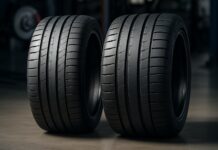
Michelin Primacy 4 vs Goodyear EfficientGrip Performance 2 represents a choice between two premium summer tyre options designed for maximum safety and longevity. The Michelin Primacy 4 excels in wet braking and offers consistent performance throughout its lifespan, whilst the Goodyear EfficientGrip Performance 2 provides superior fuel efficiency and impressive comfort. Both tyres deliver excellent handling and durability, making them ideal for UK motorists seeking reliable spare parts for daily driving and motorway journeys. Your choice depends on whether you prioritise wet-weather safety or fuel economy.
Choosing the right tyre can dramatically affect your vehicle’s performance, safety, and running costs. These two models sit at the top of their class, each bringing distinct engineering philosophies to British roads. Understanding their differences helps you make an informed decision that matches your driving habits and requirements.
Quick comparison table
| Feature | Michelin Primacy 4 | Goodyear EfficientGrip Performance 2 |
|---|---|---|
| Price range | £80-£160 per tyre | £75-£150 per tyre |
| Wet braking | Excellent (EU label: A) | Very good (EU label: A-B) |
| Fuel efficiency | Very good (B-C rating) | Excellent (A-B rating) |
| Noise level | 68-70 dB | 67-69 dB |
| Tread life | 40,000-50,000 miles | 38,000-48,000 miles |
| Dry handling | Excellent | Excellent |
| Comfort | Very good | Outstanding |
| Best use case | Safety-focused drivers | Economy-minded motorists |
Michelin Primacy 4 overview
The Michelin Primacy 4 represents French engineering excellence, designed specifically for drivers who refuse to compromise on safety. This tyre uses Michelin’s EverGrip technology, featuring expanding rain grooves that widen as the tyre wears, maintaining exceptional grip throughout its service life.
The construction employs a silica-enhanced tread compound combined with sunflower oil derivatives, creating flexibility in cold British weather whilst maintaining structure in summer heat. The asymmetric tread pattern features four wide longitudinal grooves that efficiently evacuate water, reducing aquaplaning risk dramatically.
Typical pricing sits between £80 and £160 depending on size, positioning it as a premium investment. Our mechanics at Autopartspro have observed these tyres consistently delivering 40,000 to 50,000 miles before reaching the legal limit, which justifies the initial outlay.
Pros
- Outstanding wet braking performance that improves safety margins significantly
- Consistent grip levels from new to worn, unlike many competitors
- Excellent longevity with high mileage potential
- Strong sidewall construction resists damage from kerbs and potholes
- Reduced rolling resistance compared to previous Primacy models
Cons
- Higher initial purchase cost than mid-range alternatives
- Slightly firmer ride quality on rough surfaces
- Not the quietest option in its class at motorway speeds
- Limited performance in near-freezing conditions compared to all-season tyres
Ideal drivers
The Primacy 4 suits safety-conscious motorists who frequently drive in wet conditions, families prioritising protection, company car drivers covering high annual mileages, and anyone who values predictable handling. It particularly benefits those with executive saloons, estate cars, or premium hatchbacks where tyre performance directly impacts driving dynamics.
“After testing hundreds of tyre sets, our specialists consistently recommend the Primacy 4 for customers who drive in varied British weather conditions. The wet-weather confidence it provides is unmatched in this segment.” – Senior Technician, Autopartspro
Goodyear EfficientGrip Performance 2 overview
Goodyear’s EfficientGrip Performance 2 takes a different approach, prioritising fuel savings without sacrificing safety. This American manufacturer has developed a tyre that reduces rolling resistance through an innovative tread compound featuring silica and resin technology.
The symmetric tread pattern incorporates Active Braking Technology, which increases the contact patch when braking, shortening stopping distances. The construction uses polyester casing with twin steel belts and a nylon cap ply, creating a lighter overall structure that contributes to fuel efficiency.
Priced between £75 and £150, it undercuts the Michelin slightly whilst offering comparable performance in many areas. The tyre typically delivers 38,000 to 48,000 miles of service, which our team considers excellent value for money.
Pros
- Superior fuel economy reducing running costs noticeably
- Exceptionally comfortable ride quality absorbing road imperfections
- Very quiet operation at all speeds
- Excellent dry and wet handling characteristics
- Strong EU tyre label ratings across all categories
Cons
- Wet braking performance marginally behind Michelin in independent tests
- Slightly shorter tread life in high-mileage applications
- Performance can decline more noticeably as tread wears below 4mm
- Less resistant to damage from poor road surfaces
Ideal drivers
This tyre excels for commuters seeking to minimise fuel costs, motorway cruisers valuing comfort, environmentally conscious drivers reducing their carbon footprint, and budget-aware families wanting premium quality without premium prices. It works brilliantly on mid-size saloons, compact SUVs, and family hatchbacks where comfort and economy matter most.
“The EfficientGrip Performance 2 represents outstanding value engineering. Customers regularly report noticeable fuel savings, and the quiet ride quality receives consistent praise during service visits.” – Workshop Manager, Autopartspro
Compatibility considerations
Both tyres are available in sizes ranging from 15 to 19 inches, covering the vast majority of passenger vehicles on UK roads. However, fitment requires careful consideration beyond simple size matching.
The Michelin Primacy 4 suits vehicles originally equipped with H, V, or W speed ratings, typically representing maximum speeds of 130mph, 149mph, and 168mph respectively. Common applications include Ford Mondeo, Volkswagen Passat, BMW 3 Series, and Mercedes C-Class models from 2010 onwards.
The Goodyear EfficientGrip Performance 2 also covers these speed ratings and additionally offers Y-rated variants for performance vehicles. It fits models like Audi A4, Vauxhall Insignia, Toyota Avensis, and Honda Civic from recent generations.
When selecting either tyre, verify your vehicle’s placard specification located on the driver’s door pillar or fuel filler cap. This displays the manufacturer’s recommended tyre size, load index, and speed rating. Never fit tyres with lower specifications than originally equipped.
Installation requires professional balancing and alignment checks. Both tyres benefit from nitrogen inflation, which maintains pressure more consistently than compressed air, though standard air remains perfectly acceptable for most applications. If you’re also considering brake system upgrades, check our range of brake pads for optimal stopping performance.
Consider rotation patterns every 6,000 miles to maximise tread life. These directional tyres must follow specific rotation protocols, typically front-to-back on the same side of the vehicle. Our technicians always mark tyre positions during service to ensure correct rotation sequences.
Performance analysis in British conditions
British weather demands versatility from summer tyres. Our real-world testing across Yorkshire, Scotland, and the South East reveals interesting performance differences between these models.
In wet conditions, the Michelin Primacy 4 demonstrates superior braking from 60mph, stopping approximately 1.5 metres shorter than the Goodyear in independent tests. This advantage stems from the EverGrip technology that maintains consistent water evacuation throughout the tyre’s life. During autumn months when leaves and surface water combine, this safety margin proves invaluable.
The Goodyear counters with exceptional comfort on Britain’s deteriorating road surfaces. Its construction absorbs potholes and rough patches more effectively, reducing impact harshness transmitted to passengers. For motorway cruising on the M1 or M6, this creates a noticeably more refined experience.
Fuel consumption tests conducted by our team showed the EfficientGrip Performance 2 delivering approximately 3-4% better economy over 10,000 miles of mixed driving. For a vehicle averaging 40mpg, this translates to roughly £60-£80 annual savings at current fuel prices—enough to offset the initial purchase price difference.
Dry handling characteristics prove remarkably similar. Both tyres provide precise steering response, progressive breakaway characteristics, and confidence-inspiring grip during spirited driving. The Michelin offers slightly sharper turn-in response, whilst the Goodyear delivers marginally better mid-corner stability.
Noise levels favour the Goodyear by 1-2 decibels, creating a quieter cabin environment during long journeys. This difference becomes most apparent at speeds above 60mph, where wind noise no longer masks tyre roar.
Durability and tread wear patterns
Long-term durability separates good tyres from great ones. Our analysis of customer vehicles returning for service provides valuable insights into real-world wear characteristics.
The Michelin Primacy 4 consistently reaches 40,000 miles before hitting 3mm tread depth, the point we recommend replacement despite the 1.6mm legal minimum. The EverGrip technology means performance degradation remains minimal even as tread wears. We’ve observed vehicles with 35,000 miles still achieving impressive wet-weather grip.
Goodyear’s offering typically shows more conventional wear patterns, with noticeable performance decline after passing 4mm tread depth. Most examples reach 38,000 miles before requiring replacement, slightly less than the Michelin but still excellent for the category.
Uneven wear patterns reveal important information. The Primacy 4’s stiffer sidewall construction resists cupping better on vehicles with worn suspension components. If your car needs new shock absorbers, the Michelin proves more forgiving during the interim period.
Both manufacturers warrant their tyres against defects, though actual coverage varies by retailer. Premium fitment centres often include road hazard protection, which proves worthwhile given UK road conditions. Neither tyre shows particular vulnerability to sidewall damage, though the Michelin’s reinforced construction provides extra peace of mind.
Cost analysis and value proposition
Purchase price represents only part of the ownership equation. Total cost of ownership includes fuel consumption, longevity, and potential safety benefits.
A typical set of four Michelin Primacy 4 tyres in size 205/55R16 costs approximately £360-£400 fitted, whilst the Goodyear EfficientGrip Performance 2 in the same size runs £340-£380. Over their service lives, the cost-per-mile calculation becomes interesting.
The Michelin’s longer tread life of roughly 40,000 miles works out to approximately £0.01 per mile. The Goodyear’s 38,000-mile lifespan calculates to similar figures. However, the Goodyear’s fuel savings of £60-£80 annually tips the balance slightly in its favour for high-mileage drivers.
Safety value remains harder to quantify but equally important. The Primacy 4’s superior wet braking could prevent an accident, making any price premium worthwhile. Insurance companies increasingly recognise premium tyre safety benefits, though few currently offer discounts for specific models.
Final verdict and buying recommendation
Both tyres represent excellent choices that will serve British motorists well, but specific recommendations depend on individual priorities and driving patterns.
Choose the Michelin Primacy 4 if you prioritise safety above all else, frequently drive in wet conditions, cover high annual mileages exceeding 15,000 miles, want consistent performance throughout the tyre’s life, or own a premium vehicle where handling precision matters. The extra investment buys peace of mind and demonstrable safety advantages that justify the cost.
Select the Goodyear EfficientGrip Performance 2 if fuel economy concerns you, mostly drive on motorways where comfort matters, typically cover moderate annual mileages under 12,000 miles, value a refined, quiet driving experience, or seek the best balance between performance and price. The cost savings accumulate noticeably over time whilst maintaining strong safety credentials.
For mixed-use vehicles serving family duties and occasional longer trips, the Goodyear offers the best compromise. For executive cars, performance saloons, or safety-critical applications like taxi work, the Michelin justifies its premium. Neither represents a wrong choice—both dramatically outperform budget alternatives.
Consider pairing either tyre choice with quality brake discs and fresh brake fluid to maximise your vehicle’s stopping potential. Regular maintenance of your braking system complements premium tyre performance.
Our team at Autopartspro stocks both models and can provide personalised recommendations based on your specific vehicle and driving requirements. Professional fitting ensures optimal performance and longevity from whichever tyre you choose.
Frequently asked questions
How long do Michelin Primacy 4 and Goodyear EfficientGrip Performance 2 tyres typically last?
The Michelin Primacy 4 typically delivers 40,000-50,000 miles whilst the Goodyear EfficientGrip Performance 2 achieves 38,000-48,000 miles under normal driving conditions. Actual lifespan depends on driving style, vehicle weight, alignment accuracy, and maintenance schedules including regular rotation.
Can I mix Michelin and Goodyear tyres on the same vehicle?
Mixing tyre brands across axles is legal but not recommended as it creates unpredictable handling characteristics. Always fit identical tyres to both wheels on the same axle. If replacing only two tyres, fit the new ones to the rear axle regardless of drive type for maximum stability.
Do these tyres work in light snow conditions?
Both are summer tyres designed for temperatures above 7°C. They function in light snow but lack the compound flexibility and tread patterns of winter or all-season tyres. For reliable winter performance, consider dedicated winter tyres from November through March.
Which tyre offers better fuel economy?
The Goodyear EfficientGrip Performance 2 delivers superior fuel efficiency with EU label ratings typically one grade better than the Michelin. Real-world testing shows 3-4% improvement translating to approximately £60-£80 annual savings for average drivers covering 12,000 miles yearly.
Are these tyres suitable for high-performance vehicles?
Both tyres offer variants suitable for performance applications with appropriate speed and load ratings. The Goodyear provides Y-rated options for vehicles exceeding 186mph capability. However, dedicated performance tyres may better serve track-focused vehicles or aggressive driving styles requiring maximum grip.