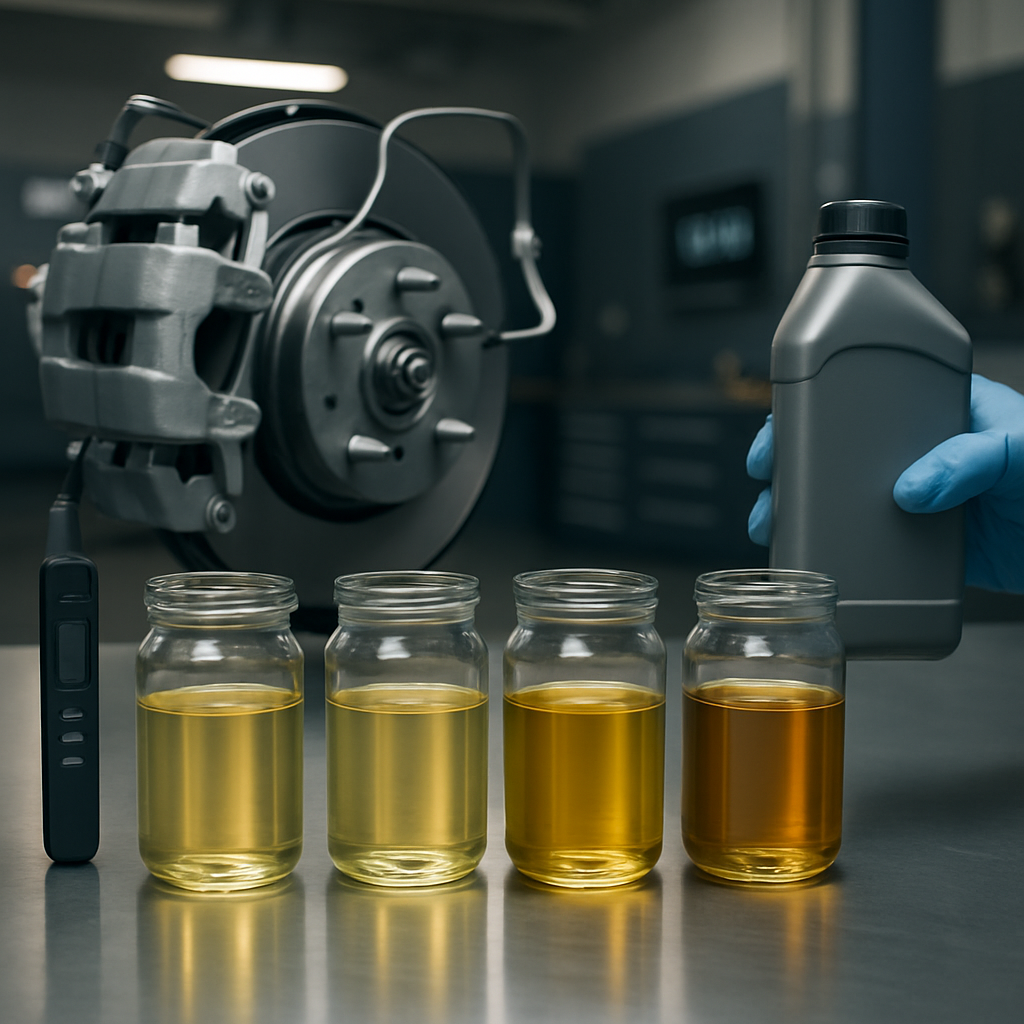
Bremsevæske med DOT 3, DOT 4, DOT 5.1 og DOT 5 differs primarily in boiling points, chemical composition, and hygroscopic properties. DOT 3 and DOT 4 are glycol-based fluids that absorb moisture over time, whilst DOT 5 is silicone-based and doesn’t mix with water. DOT 5.1 offers the highest boiling point among glycol types, making it ideal for performance applications. For most UK drivers, DOT 4 provides the best balance between safety, cost, and compatibility with modern braking systems, including those with ABS and electronic stability control.
Quick comparison table
| Specification | DOT 3 | DOT 4 | DOT 5.1 | DOT 5 |
|---|---|---|---|---|
| Base composition | Glycol-ether | Glycol-ether/borate | Glycol-ether/borate | Silicone |
| Dry boiling point | 205°C | 230°C | 260°C | 260°C |
| Wet boiling point | 140°C | 155°C | 180°C | 180°C |
| Hygroscopic | Yes | Yes | Yes | No |
| Price range | £5-£8/litre | £8-£12/litre | £12-£18/litre | £15-£25/litre |
| Replacement interval | 2 years | 2 years | 2 years | 5 years |
| Best use case | Older vehicles | Modern daily drivers | Performance/track use | Classic/military vehicles |
The table above shows critical differences that affect your vehicle’s braking performance. Each specification serves distinct purposes, and choosing incorrectly can compromise safety.
DOT 3 brake fluid overview
DOT 3 represents the most basic glycol-based brake fluid available. It’s formulated from polyethylene glycol ethers mixed with additives that prevent corrosion and maintain viscosity across temperature ranges.
This fluid type works through hydraulic pressure transmission from the master cylinder to brake callipers. When you press the brake pedal, the incompressible liquid transfers force instantly, activating your brake pads against the rotors.
The typical price ranges from £5 to £8 per litre, making it the most economical option. You’ll find DOT 3 specified mainly in older vehicles manufactured before 2000, particularly those without advanced braking systems.
Advantages:
- Lowest cost option for standard applications
- Widely available at most auto parts retailers
- Compatible with older brake system seals and components
- Adequate for vehicles with minimal brake stress
Disadvantages:
- Lower boiling point increases vapour lock risk during heavy braking
- Absorbs moisture rapidly, reducing effectiveness within 12-18 months
- Not suitable for modern vehicles with ABS or traction control
- Requires more frequent replacement cycles
DOT 3 suits drivers with classic cars or budget vehicles that see gentle driving conditions. If you’re navigating steep hills or towing regularly, this specification won’t provide adequate protection. Our mechanics at Autopartspro recommend DOT 3 only for vehicles specifically requiring it in the owner’s manual.
Always check your vehicle’s brake fluid reservoir cap or owner’s manual before purchasing. Using a lower specification than required can void warranties and create dangerous braking fade.
DOT 4 brake fluid overview
DOT 4 contains glycol-ether base stocks enhanced with borate esters, providing superior thermal stability compared to DOT 3. This chemical composition delivers higher boiling points and better moisture resistance, though it still absorbs water over time.
The fluid operates identically to DOT 3 in hydraulic systems but maintains performance under greater thermal stress. Modern vehicles generate substantial heat during braking, particularly those equipped with brake discs and electronic brake distribution systems.
Expect to pay between £8 and £12 per litre for quality DOT 4 fluid. Most vehicles manufactured after 2000 specify this grade, including those with ABS, electronic stability programmes, and brake assist features.
Advantages:
- Higher boiling points prevent vapour lock during demanding driving
- Compatible with all modern brake system materials and seals
- Works with ABS, ESP, and other electronic brake systems
- Better moisture tolerance extends service intervals slightly
- Can replace DOT 3 in older systems without issues
Disadvantages:
- More expensive than DOT 3 without significant daily driving benefits
- Still hygroscopic, requiring biennial replacement
- Performance degrades noticeably once contaminated with moisture
- Not ideal for extreme performance or track applications
DOT 4 serves as the ideal choice for typical UK motorists driving modern saloons, estates, and SUVs. It handles motorway speeds, city traffic, and occasional spirited driving without compromising safety. The Autopartspro technical team considers DOT 4 the minimum acceptable standard for any vehicle built this century, particularly those exceeding 1,400 kg kerb weight.
DOT 5.1 brake fluid overview
DOT 5.1 shouldn’t be confused with DOT 5 despite the similar naming. This fluid uses an advanced glycol-ether formulation with sophisticated borate ester additives, achieving the highest boiling points in the glycol family.
The hydraulic operation remains identical to DOT 3 and DOT 4, but the enhanced thermal stability prevents boiling under extreme conditions. Racing applications, mountain descents, and heavy towing create temperatures that would cause lower-grade fluids to fail catastrophically.
Pricing sits between £12 and £18 per litre, reflecting the premium formulation. Performance vehicles, sports cars, and modified machines often specify DOT 5.1 from the factory.
Advantages:
- Exceptional dry and wet boiling points for maximum safety margins
- Maintains brake pedal feel during repeated hard stops
- Fully compatible with DOT 3 and DOT 4 systems
- Essential for track days and performance driving
- Handles extreme ambient temperatures better
Disadvantages:
- Significantly more expensive than standard grades
- Hygroscopic properties still require biennial changes
- Overkill for normal street driving conditions
- Limited availability in smaller retailers
Choose DOT 5.1 if you own a performance car, regularly participate in track events, or tow heavy loads through mountainous terrain. The higher cost proves worthwhile when brake fade could mean the difference between safe stops and accidents. Our Autopartspro specialists have seen numerous cases where upgrading to DOT 5.1 eliminated brake problems in modified vehicles running larger wheels and uprated brake callipers.
Never mix DOT 5 silicone fluid with DOT 5.1 glycol fluid. Despite similar names, they’re chemically incompatible and mixing them will destroy your entire brake system.
DOT 5 brake fluid overview
DOT 5 breaks from tradition entirely by using silicone polymer base stocks instead of glycol compounds. This fundamental difference creates unique properties that suit specific applications whilst being unsuitable for most modern vehicles.
The silicone formulation doesn’t absorb water, which sounds advantageous but creates problems in real-world conditions. Any moisture entering the system forms droplets rather than dissolving, leading to localised corrosion and ice formation in cold climates.
Prices range from £15 to £25 per litre, reflecting specialised production volumes. You’ll find DOT 5 specified primarily in classic cars, military vehicles, and motorcycles where long-term storage is common.
Advantages:
- Non-hygroscopic nature prevents moisture-related boiling point degradation
- Extended service life of 5 years or more
- Won’t damage paint if spilled during maintenance
- Ideal for vehicles in long-term storage
- Maintains consistent viscosity across wide temperature ranges
Disadvantages:
- Incompatible with ABS, traction control, and modern brake electronics
- Cannot mix with any glycol-based fluid without complete system flush
- Compressible nature creates spongy pedal feel
- Water contamination causes severe localised corrosion
- More expensive with limited performance benefits
- Aeration issues during rapid pedal pumping
DOT 5 serves classic car enthusiasts and military vehicle owners exclusively. The non-hygroscopic properties benefit vehicles stored for months between uses, preventing the moisture accumulation that plagues glycol fluids. However, attempting to use DOT 5 in a modern car with electronic brake systems will result in complete system failure. The Autopartspro workshop has repaired several vehicles where owners mistakenly added DOT 5 to DOT 4 systems, requiring complete brake system replacement costing thousands of pounds.
Compatibility considerations
Understanding brake fluid compatibility prevents expensive mistakes and dangerous situations. The wrong fluid can dissolve seals, damage ABS pumps, and cause complete brake failure.
Glycol fluid mixing: DOT 3, DOT 4, and DOT 5.1 can be mixed together safely because they share glycol-ether base chemistry. However, mixing different grades will result in the performance characteristics of the lowest specification present. If you add DOT 3 to a DOT 4 system, the entire fluid behaves like DOT 3 with its lower boiling point.
Silicone separation: DOT 5 must never contact glycol-based fluids. The incompatible chemistries create gel-like substances that block brake lines and destroy seals. Converting from glycol to silicone requires complete system disassembly, thorough cleaning, and seal replacement throughout.
Vehicle age considerations: Pre-1970 vehicles often used natural rubber seals that swell excessively with modern DOT 4 fluids. These classics may require DOT 3 or specialised fluids formulated for vintage applications. Conversely, vehicles from the 1990s onwards use synthetic seals designed for DOT 4, and using DOT 3 may cause seal shrinkage and leaks.
ABS system requirements: Anti-lock braking systems contain rapid-cycling valves and high-speed pumps that generate significant heat. These systems universally require DOT 4 minimum, with many manufacturers specifying DOT 5.1 for performance models. The lower viscosity and higher boiling points prevent valve sticking and ensure precise pressure modulation.
Model year specifications: Always consult your vehicle’s documentation before purchasing brake fluid. Manufacturers conduct extensive testing to determine optimal specifications. Using a higher grade (DOT 4 instead of DOT 3) is generally safe, but never use a lower specification than recommended.
Installation notes: Brake fluid attracts moisture from the air within minutes of opening the container. Only open bottles immediately before use and seal them tightly afterwards. When bleeding brakes, work quickly to minimise atmospheric exposure. Use a vacuum bleeder or pressure bleeder to reduce the time the system remains open.
Our Autopartspro technicians recommend keeping unopened brake fluid in your garage rather than partially used containers. Once opened, fluid begins absorbing moisture immediately, even from air inside the bottle. For DIY mechanics, purchase the exact amount needed rather than storing leftovers.
Final verdict
For the vast majority of UK drivers operating modern vehicles, DOT 4 brake fluid represents the optimal choice. It provides the necessary thermal stability for daily driving, compatibility with electronic brake systems, and reasonable cost at £8-£12 per litre. Replace it every two years regardless of mileage to maintain safety margins.
Select DOT 5.1 if you own a performance car, regularly drive through mountainous regions, or participate in track days. The £12-£18 per litre cost pays dividends when braking from high speeds repeatedly. The elevated boiling points prevent fade that could otherwise prove catastrophic.
Choose DOT 3 only if your classic vehicle specifically requires it and you drive gently without demanding stops. The £5-£8 per litre savings aren’t worth the reduced safety margins in modern traffic conditions.
Avoid DOT 5 entirely unless you own a classic car or military vehicle designed for it. The incompatibility with modern brake systems and the risk of mixing with glycol fluids create more problems than the extended service life solves. If your vehicle currently uses DOT 5, continue with it but never add glycol-based fluid.
When in doubt, consult your owner’s manual or the brake fluid reservoir cap, which typically displays the required specification. Upgrading one grade (DOT 3 to DOT 4, or DOT 4 to DOT 5.1) is safe, but never downgrade or switch between glycol and silicone types. The small cost savings aren’t worth the catastrophic brake failure risk.
Can I mix different DOT brake fluids?
You can safely mix DOT 3, DOT 4, and DOT 5.1 because they share glycol-ether chemistry. However, the mixture will perform at the lowest specification present. Never mix DOT 5 silicone fluid with any glycol type, as they’re chemically incompatible and will damage your entire braking system.
How often should I change brake fluid?
Replace glycol-based brake fluids (DOT 3, 4, and 5.1) every two years regardless of mileage. These fluids absorb moisture from the atmosphere, which lowers boiling points and causes internal corrosion. DOT 5 silicone fluid lasts five years but suits only specific classic vehicles without ABS.
Why does brake fluid boiling point matter?
When brake fluid boils, it creates vapour bubbles that compress under pedal pressure instead of transmitting force to the callipers. This causes complete brake failure called vapour lock. Higher boiling points prevent this during heavy braking, mountain descents, or towing when temperatures exceed 200°C in the system.
What happens if I use wrong brake fluid?
Using lower specifications than required causes brake fade and potential vapour lock. Mixing silicone DOT 5 with glycol fluids destroys seals and creates gel blockages. Using DOT 4 in vintage cars designed for DOT 3 may swell old rubber seals. Always follow manufacturer specifications to avoid expensive repairs.
Does brake fluid damage car paint?
Glycol-based brake fluids (DOT 3, 4, and 5.1) strip paint within minutes of contact, requiring immediate washing with water. DOT 5 silicone fluid won’t harm paint, making it popular for show cars. Always cover painted surfaces with cloth when working with brake systems to prevent accidental spills causing damage.