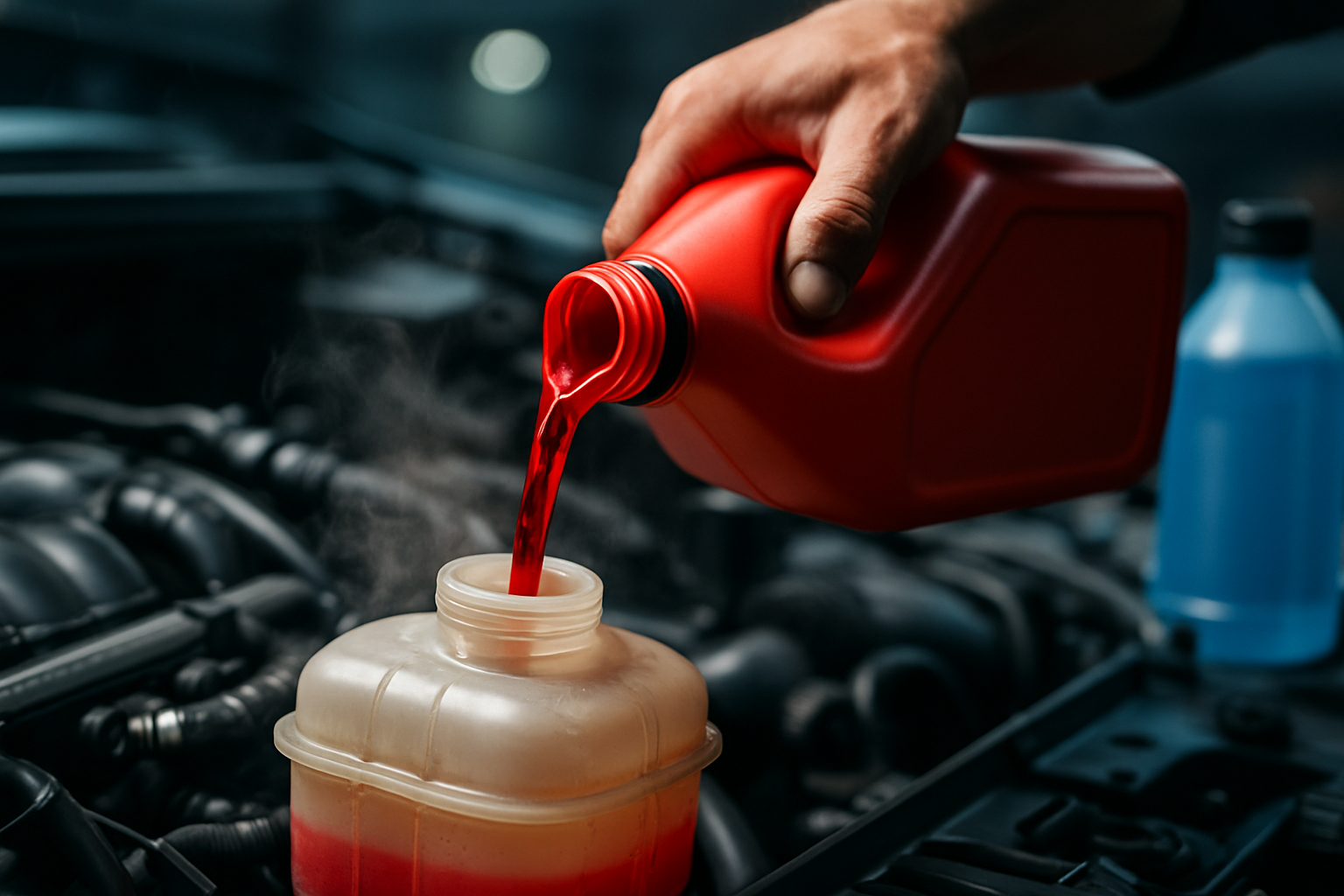
When choosing between red or blue coolant for your vehicle, the critical factor is your manufacturer’s specification. Red coolant (OAT – Organic Acid Technology) is typically ethylene glycol-based with longer service intervals, whilst blue coolant (IAT – Inorganic Additive Technology) uses silicate-based formulas requiring more frequent changes. Never mix different coolant types, as this causes chemical reactions that reduce protection and can damage engine components. Always consult your owner’s manual or check the existing coolant colour before topping up or replacing.
The choice between red and blue coolant isn’t simply aesthetic. These colours indicate fundamentally different chemical formulations designed for specific engine types and materials. Modern vehicles demand precise coolant specifications, and using the wrong type can lead to corrosion, overheating, and expensive repairs.
Our mechanics at Autopartspro have seen countless cases where incorrect coolant selection has resulted in radiator damage, water pump failure, and corroded engine blocks. Understanding the technical differences between coolant types is essential for proper vehicle maintenance.
Professional tip: Before purchasing coolant, photograph your current reservoir cap or check the service book. Most manufacturers clearly specify which coolant type your engine requires, and deviation from this specification can void warranties.
Quick comparison table
| Attribute | Red Coolant (OAT) | Blue Coolant (IAT) |
|---|---|---|
| Price range | £15-25 per 5 litres | £10-18 per 5 litres |
| Service interval | 5 years / 150,000 miles | 2 years / 30,000 miles |
| Chemical base | Organic acids | Silicates & phosphates |
| Corrosion protection | Excellent long-term | Good short-term |
| Engine compatibility | Modern aluminium engines | Older cast iron engines |
| Best use case | Post-2000 vehicles | Pre-2000 vehicles |
Red coolant overview
Red coolant represents the newer generation of engine coolants, utilising Organic Acid Technology. This formulation relies on organic acids rather than traditional inorganic additives to provide corrosion protection. The technology works by forming a thin protective layer only where corrosion begins, rather than coating all internal surfaces.
The base material is typically ethylene glycol or propylene glycol mixed with deionised water and organic acid inhibitors. These inhibitors include sebacate, 2-ethylhexanoic acid, and other organic compounds that don’t deplete as rapidly as traditional additives.
Red OAT coolants typically cost between £15 and £25 for a 5-litre container. Whilst initially more expensive than traditional blue coolants, the extended service life makes them economically advantageous over time. Many manufacturers supply these as concentrated solutions requiring 50:50 mixing with distilled water, whilst others offer pre-mixed formulations.
The primary advantage of red coolant is its extended service interval. Quality OAT formulations can last 5 years or 150,000 miles before replacement becomes necessary. This longevity stems from the stable organic acid inhibitors that don’t deplete through typical engine operation. The formulation also provides superior aluminium protection, making it ideal for modern engine blocks and cylinder heads.
However, red coolants have disadvantages. They’re incompatible with older engine designs featuring extensive copper or brass components. The organic acids can actually accelerate corrosion in these materials. Additionally, OAT coolants require longer to establish full corrosion protection after initial fill, taking several hundred miles of operation to form protective layers properly.
Red coolant is ideal for drivers of modern vehicles manufactured after 2000, particularly those with predominantly aluminium engine construction. If your vehicle covers high annual mileage and you want to minimise maintenance intervals, red OAT coolant offers excellent value. It’s particularly suitable for fleet vehicles and company cars where extended service intervals reduce downtime and maintenance costs.
Blue coolant overview
Blue coolant represents traditional Inorganic Additive Technology that has protected engines for decades. This older formulation uses silicates, phosphates, and sometimes borates to provide rapid corrosion protection across all metal surfaces within the cooling system.
The chemical composition centres on ethylene glycol combined with inorganic salts. These salts immediately coat all internal surfaces when introduced to the system, providing instant protection against corrosion and cavitation. The silicate content is particularly effective at protecting aluminium components, whilst phosphates safeguard iron and steel surfaces.
Blue IAT coolants are generally more affordable, ranging from £10 to £18 for 5 litres. This lower cost reflects both the simpler manufacturing process and shorter service life. Like red coolants, blue variants are available as concentrated or pre-mixed formulations. When purchasing concentrate, always mix with distilled or deionised water rather than tap water to prevent mineral deposits.
The main advantage of blue coolant is immediate protection. The moment it circulates through your engine, protective layers form on all metal surfaces. This makes it excellent for older engines with mixed metallurgy, including copper radiators, brass fittings, and cast iron blocks. The formulation has proven reliability spanning decades of use across millions of vehicles.
The primary disadvantage is frequent replacement requirements. Inorganic additives deplete relatively quickly, typically requiring coolant changes every 2 years or 30,000 miles. The silicates can also form gel-like deposits if the coolant becomes contaminated or overheated, potentially blocking narrow passages in radiators and heater matrices. Blue coolant is also less environmentally friendly due to more frequent disposal requirements.
Blue coolant suits owners of pre-2000 vehicles, particularly British, European, and Japanese cars from the 1980s and 1990s. If your vehicle features a copper-brass radiator or has extensive brass fittings throughout the cooling system, blue IAT coolant provides superior protection. It’s also appropriate for classic car enthusiasts who prefer maintaining originality with period-correct specifications.
Expert insight from Autopartspro technicians: We’ve observed that mixing red and blue coolants creates a brown sludge that can block radiator cooling fans and narrow passages. If you’re uncertain which coolant your vehicle contains, drain and flush the entire system before introducing new coolant.
Compatibility
Vehicle compatibility is paramount when selecting coolant. Using incorrect coolant can void manufacturer warranties and cause significant mechanical damage. Modern vehicles manufactured after 2000 overwhelmingly require OAT (red) coolants, whilst vehicles from the 1980s and 1990s typically specify IAT (blue) formulations.
For model year considerations, Japanese manufacturers like Toyota, Honda, and Nissan transitioned to OAT coolants between 1998 and 2002. European manufacturers including Volkswagen, BMW, and Mercedes-Benz adopted OAT technology slightly earlier, around 1996-1998. British marques such as Land Rover and Jaguar made the switch throughout the late 1990s. Always verify your specific model year against manufacturer specifications rather than relying solely on these general timelines.
OEM specifications vary significantly between manufacturers. Volkswagen Group vehicles often require G12+ or G13 specification coolants, which are OAT-based but have specific additive packages. BMW specifies coolants meeting their own stringent standards, whilst Ford uses Motorcraft-branded coolants formulated to their requirements. Generic red or blue coolants may not meet these exacting specifications, potentially leading to warranty issues.
When it comes to installation notes, never mix coolant types under any circumstances. If you’re transitioning from blue to red coolant (or vice versa), completely drain the system, flush thoroughly with clean water, and refill with the correct specification. Pay particular attention to bleeding air from the system after filling, as airlocks can cause overheating and engine damage. Most modern vehicles have specific bleeding procedures involving running the engine with the heater on full whilst topping up the expansion tank.
Check your expansion tank regularly for contamination. If coolant appears brown, murky, or contains floating particles, this indicates mixing or contamination requiring immediate attention. Similarly, inspect radiator hoses for softening or swelling, which can indicate incorrect coolant attacking rubber components.
Temperature protection is another critical compatibility factor. Most coolants provide freeze protection to approximately -36°C when mixed 50:50 with water. However, UK winters rarely demand this level of protection. A 40:60 coolant-to-water ratio provides adequate freeze protection whilst improving heat transfer efficiency. Never use coolant without dilution, as concentrated coolant actually has poorer heat transfer properties than properly mixed solutions.
Final verdict
Choose red OAT coolant if you drive a vehicle manufactured after 2000, particularly if it features an aluminium engine block and cylinder head. The extended 5-year service interval makes red coolant the economical choice for high-mileage drivers and those wanting to minimise maintenance schedules. Red coolant is also preferable if you’re environmentally conscious, as less frequent changes mean reduced disposal requirements.
Opt for blue IAT coolant if you own a pre-2000 vehicle, especially one with a copper-brass radiator or extensive brass fittings. The immediate protection blue coolant provides is valuable for older engines that may have minor internal corrosion or deposits. Classic car owners should particularly consider blue coolant for authenticity and compatibility with vintage materials. Despite more frequent changes, blue coolant remains the technically correct choice for older vehicle designs.
For professional fleet managers, red OAT coolant reduces maintenance overhead and vehicle downtime. For enthusiasts restoring classic vehicles, blue IAT coolant maintains period correctness whilst providing proven protection. Regardless of which you choose, never compromise on quality. Premium branded coolants from established manufacturers provide far superior protection compared to budget alternatives that may not meet critical specifications.
If you’re performing maintenance yourself, invest in proper water pump inspection during coolant changes. A failing water pump can contaminate fresh coolant with bearing grease and metal particles. Similarly, examine your thermostat operation, as a stuck thermostat can cause localised overheating regardless of coolant quality.
Can I mix red and blue coolant in an emergency?
Absolutely not, even in emergencies. Mixing red and blue coolant causes chemical reactions forming gel-like precipitates that block narrow cooling passages. If you’re low on coolant and don’t have the correct type available, use plain distilled water temporarily, then drain and refill properly as soon as possible.
How do I know which coolant my car currently has?
Check the expansion tank or radiator reservoir. The coolant colour is usually clearly visible. Alternatively, consult your owner’s manual or service book, which specifies the correct coolant type. Most manufacturers also place stickers under the bonnet indicating coolant specifications for quick reference.
Does coolant colour always indicate the type?
Not always. Whilst red typically indicates OAT and blue indicates IAT, some manufacturers use different colour coding. Orange, pink, and green coolants also exist with varying formulations. Always verify the specification on the bottle label rather than relying solely on colour identification.
How often should I check my coolant level?
Check coolant level monthly when the engine is cold. The level should sit between the minimum and maximum marks on the expansion tank. If you’re regularly topping up, this indicates a leak requiring immediate investigation to prevent catastrophic engine damage from overheating.
Can I use universal coolant in any vehicle?
Universal coolants claim compatibility with all systems, but proceed cautiously. These products often contain additives attempting to satisfy multiple specifications simultaneously. For critical applications or newer vehicles under warranty, stick with manufacturer-specified coolants to ensure proper protection and maintain warranty validity.