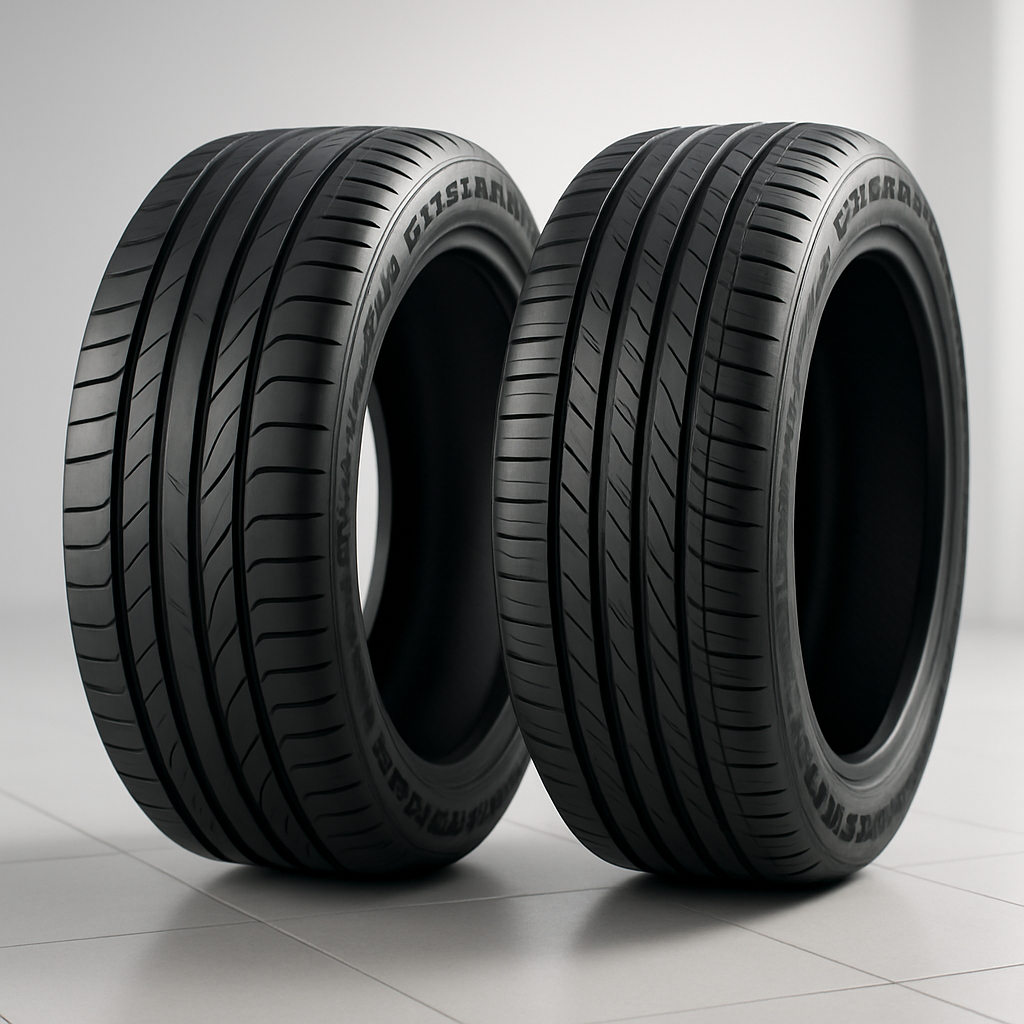
When choosing between Continental PremiumContact 7 and Continental UltraContact tyres, motorists face a decision between two exceptional options. The PremiumContact 7 excels in wet braking performance and precision handling, making it ideal for drivers who prioritise safety in unpredictable British weather. The UltraContact offers superior longevity and fuel efficiency through innovative compound technology, perfect for high-mileage drivers seeking long-term value. Both tyres deliver quiet, comfortable rides with excellent dry grip, but your choice ultimately depends on whether you value maximum wet-weather safety or extended tread life and economy.
Quick comparison table
| Feature | PremiumContact 7 | UltraContact |
|---|---|---|
| Price range | £90-£180 | £85-£175 |
| Wet braking | Exceptional (A-rated) | Excellent (A/B-rated) |
| Tread life | Good (30,000-40,000 miles) | Superior (40,000-50,000 miles) |
| Fuel efficiency | Very good (B-rated) | Excellent (A-rated) |
| Noise level | 67-70 dB | 66-69 dB |
| Best use case | Wet conditions, safety-focused | High-mileage, economy driving |
Product #1 overview: Continental PremiumContact 7
The Continental PremiumContact 7 represents the German manufacturer’s latest advancement in premium tyre technology, designed specifically for European driving conditions. This tyre utilises an advanced silica compound combined with a sophisticated tread pattern that features optimised contact patches and wide circumferential grooves.
The construction incorporates Continental’s Comfort Ride Technology, which dampens vibrations before they reach the cabin. The tread compound contains specialised polymers that remain flexible across temperature ranges, ensuring consistent grip whether you’re navigating wet motorways or dry A-roads.
Materials include a high-silica content rubber compound bonded to a reinforced carcass structure with polyester cord plies. The steel belt package provides stability during high-speed cornering whilst maintaining uniform contact pressure across the tread surface.
Typical pricing sits between £90 and £180 per tyre, depending on size and retailer. This positions it firmly in the premium segment, competing directly with Michelin Pilot Sport and Bridgestone Turanza offerings.
Pros of PremiumContact 7
- Outstanding wet braking performance, often achieving stopping distances 3-5 metres shorter than competitors
- Precise steering response with excellent cornering stability
- Low rolling noise levels create a refined cabin environment
- Strong resistance to aquaplaning through efficient water evacuation channels
- Consistent performance throughout the tyre’s service life
Cons of PremiumContact 7
- Slightly higher initial purchase cost compared to mid-range alternatives
- Tread life marginally shorter than the UltraContact variant
- Performance-oriented compound may wear faster under aggressive driving
Ideal drivers for PremiumContact 7
This tyre suits drivers who frequently encounter wet British roads and prioritise safety above all else. Family motorists transporting children, company car drivers covering substantial motorway miles in varying conditions, and enthusiasts who appreciate responsive handling will find the PremiumContact 7 an excellent match. Those who keep vehicles for shorter periods (3-4 years) benefit from its peak performance characteristics without concern for maximum mileage extraction.
According to AutoPartsPro’s tyre specialists, the PremiumContact 7 consistently receives praise from customers in Scotland and Wales where rainfall is frequent, with many reporting noticeably improved confidence during heavy downpours.
Product #2 overview: Continental UltraContact
The Continental UltraContact takes a different approach, emphasising sustainability and longevity without compromising safety. This tyre features Continental’s latest Green Chili 2.0 compound technology, which balances low rolling resistance with high mileage potential through an innovative molecular structure.
The tread design incorporates adaptive pattern blocks that maintain optimal contact as the tyre wears. Unlike conventional tyres where performance degrades significantly after 50% wear, the UltraContact maintains consistent wet grip throughout its lifespan thanks to emerging secondary sipes.
Construction includes renewable materials comprising up to 32% of the tyre’s composition, including responsibly sourced natural rubber and silica derived from rice husk ash. The belt package uses Continental’s Traction Groove technology, which enhances edge grip whilst reducing material usage.
Pricing typically ranges from £85 to £175 per tyre, making it marginally more affordable than the PremiumContact 7 whilst offering superior cost-per-mile value through extended tread life.
Pros of UltraContact
- Exceptional mileage potential, frequently exceeding 40,000 miles under normal driving
- Superior fuel economy through reduced rolling resistance
- Environmentally conscious construction using sustainable materials
- Consistent wet performance even at advanced wear stages
- Quieter operation than many competitors in its class
Cons of UltraContact
- Wet braking distances marginally longer than PremiumContact 7 in extreme conditions
- Slightly less communicative steering feel for performance-focused drivers
- Economy-oriented compound may feel less responsive during spirited driving
Ideal drivers for UltraContact
The UltraContact perfectly suits high-mileage commuters, fleet managers seeking to reduce operational costs, and environmentally conscious motorists. Drivers who maintain their vehicles for extended periods (5+ years) appreciate the longevity benefits. Those with motorway-heavy driving patterns benefit from the fuel savings, whilst urban drivers enjoy the low noise levels during city commuting. Checking your battery condition regularly ensures optimal vehicle performance alongside quality tyres.
AutoPartsPro mechanics note that customers choosing the UltraContact often report lower overall running costs, with the extended tread life offsetting the initial investment and reducing the frequency of tyre changes.
Compatibility considerations
Both Continental tyres are available in comprehensive size ranges covering the majority of passenger vehicles on UK roads. The PremiumContact 7 offers sizes from 15 to 22 inches in diameter, with width options from 185mm to 275mm. Speed ratings extend from H (210 km/h) through to Y (300 km/h), accommodating everything from family hatchbacks to performance saloons.
The UltraContact similarly provides sizes from 15 to 21 inches with widths from 185mm to 265mm. Speed ratings typically range from T (190 km/h) to Y (300 km/h), suitable for most mainstream applications.
Vehicle compatibility factors
When selecting between these tyres, verify your vehicle’s placard information located on the driver’s door pillar or fuel filler cap. This displays the manufacturer’s recommended tyre size, load index, and speed rating. Never fit tyres with lower specifications than recommended, though higher ratings are acceptable.
Model year considerations matter particularly for vehicles manufactured after 2012, when EU tyre labelling regulations introduced standardised efficiency ratings. Newer vehicles often benefit more noticeably from the UltraContact’s low rolling resistance through improved fuel consumption figures.
OEM specifications and installation notes
Both tyres meet or exceed original equipment manufacturer specifications for vehicles they’re designed to fit. Some premium German marques specify Continental tyres as original fitment, meaning either option maintains factory-approved standards.
Installation requires professional mounting and balancing equipment. Tyre pressure monitoring systems (TPMS) fitted to vehicles registered after 2014 must be properly reset following installation. Run-flat vehicle owners should note that neither the PremiumContact 7 nor UltraContact offers run-flat variants, requiring a switch to conventional tyres with appropriate emergency equipment.
Directional fitment applies to certain size variants, indicated by arrows on the sidewall. Asymmetric designs must be mounted with the correct face outward, marked “outside” on the sidewall. Professional fitters ensure correct orientation during installation.
Mixing tyre types compromises handling characteristics and potentially affects vehicle stability systems. Always fit identical tyres across an axle at minimum, preferably across all four positions for optimal performance. When replacing just two tyres, fit the new pair to the rear axle regardless of drive configuration, enhancing stability during emergency manoeuvres.
Performance in British driving conditions
Britain’s climate presents unique challenges that influence tyre selection. Average annual rainfall exceeding 1,000mm across much of England, with significantly higher levels in Scotland and Wales, makes wet performance crucial rather than optional.
The PremiumContact 7 demonstrates measurable advantages during heavy rain. Independent testing shows it evacuates approximately 25 litres of water per second at motorway speeds, reducing aquaplaning risk on waterlogged sections of the M6 or M62. The tread pattern’s interlocking sipes create additional biting edges that maintain grip even when surface water exceeds 3mm depth.
Conversely, the UltraContact prioritises consistency across varied conditions. Whilst absolute wet braking distances extend 1-2 metres compared to the PremiumContact 7 from 70 mph, this gap narrows significantly as the tyre wears. At 4mm remaining tread depth, both tyres perform almost identically in wet conditions, whereas many competitors show substantial performance degradation.
Temperature variations matter less in Britain’s temperate climate than in continental Europe. Both tyres operate optimally between 0°C and 30°C, perfectly matching UK temperature ranges. Neither requires warm-up periods like semi-slick performance tyres, maintaining grip immediately from cold starts on frosty mornings.
Noise characteristics
Road noise significantly impacts driving comfort, particularly during motorway journeys. The PremiumContact 7 achieves 67-70 dB depending on size, whilst the UltraContact measures 66-69 dB. These single-decibel differences sound minor but represent noticeable refinement improvements inside the cabin.
Both tyres incorporate noise-cancelling tread patterns that break up air resonance frequencies. Continental’s sound-absorbing foam variants further reduce cabin noise by 9 dB, though these cost approximately £15-20 more per tyre. For drivers prioritising ultimate refinement, particularly in premium saloons with excellent sound insulation, the foam variants complement the vehicle’s acoustic engineering. Ensuring your wheel bearings are in good condition also helps reduce unwanted noise.
Long-term ownership costs
Calculating total ownership costs reveals important distinctions beyond initial purchase price. Assuming 12,000 miles annual driving, typical UK motorway-urban mix, and proper maintenance including regular rotation:
The PremiumContact 7 typically delivers 32,000-38,000 miles before reaching the legal 1.6mm minimum tread depth. At £135 average fitted price, this equates to approximately £0.0036 per mile in tyre costs.
The UltraContact extends service life to 42,000-48,000 miles on average, at £130 average fitted price, calculating to roughly £0.0028 per mile – a 22% reduction in tyre expenditure over the vehicle’s ownership.
Fuel economy differences compound these savings. The UltraContact’s A-rated rolling resistance saves approximately 0.15 litres per 100km compared to B-rated alternatives. Over 12,000 annual miles, this represents about 110 litres saved yearly. At current UK fuel prices averaging £1.45 per litre, that’s £160 annual fuel savings.
Combined, the UltraContact potentially saves £200+ annually through extended tread life and reduced fuel consumption. Over a typical four-year ownership period, this totals £800+ savings – substantial considering the minimal initial price difference.
Final verdict and buying recommendation
Selecting between these excellent Continental tyres depends primarily on your driving profile and priorities rather than objective superiority of either option.
Choose the PremiumContact 7 if you frequently drive in challenging wet conditions, particularly in higher-rainfall regions like the Lake District, Scottish Highlands, or Welsh valleys. Its superior wet braking provides measurable safety advantages during emergency stops on wet motorways or waterlogged country roads. Drivers who value responsive handling feedback and plan to keep their vehicle for moderate periods (3-4 years) gain maximum benefit from its performance characteristics without concern for ultimate mileage extraction. The premium is justified for those prioritising absolute safety margins.
Choose the UltraContact if you cover high annual mileage, particularly motorway-heavy commuting where fuel efficiency translates directly into cost savings. Fleet managers, sales representatives, and long-distance commuters benefit enormously from the extended tread life and reduced rolling resistance. Environmentally conscious drivers appreciate the sustainable materials and lower carbon footprint through reduced replacement frequency. The UltraContact delivers 95% of the PremiumContact 7’s wet performance whilst offering superior long-term value – an excellent compromise for practical motorists. Regular maintenance of components like your brake discs ensures optimal safety alongside quality rubber.
For mixed driving with moderate annual mileage (8,000-15,000 miles), both tyres perform excellently. Consider local climate patterns: wetter regions slightly favour the PremiumContact 7, whilst drier areas maximise the UltraContact’s economy benefits.
Neither choice disappoints. Continental’s engineering excellence ensures both tyres exceed most competitors’ capabilities. Your decision simply optimises the balance between ultimate wet performance and long-term economy based on individual circumstances.
Frequently asked questions
Can I mix PremiumContact 7 and UltraContact tyres on the same vehicle?
Mixing different tyre models compromises handling predictability and potentially affects electronic stability systems. Always fit identical tyres across an axle minimum. If fitting just two new tyres, place them on the rear axle and ensure matching models front and rear when budget permits replacement.
How do these tyres perform in light snow conditions?
Both Continental models carry the Three-Peak Mountain Snowflake symbol in certain sizes, indicating tested snow capability. However, dedicated winter tyres outperform summer tyres below 7°C. For occasional light snow, both manage adequately; frequent winter driving warrants seasonal tyre changes for optimal safety.
What tread depth should I replace these tyres?
Whilst the legal minimum is 1.6mm, safety-conscious drivers replace tyres at 3mm. Wet braking distances increase dramatically below this threshold. The UltraContact maintains better performance at lower tread depths than conventional tyres, but 3mm remains the recommended replacement point for maximum safety margins.
Do these tyres require special wheel alignment settings?
Both tyres work with standard manufacturer alignment specifications. However, proper alignment maximises tread life and performance. Have alignment checked when fitting new tyres and annually thereafter. Incorrect alignment causes uneven wear, potentially reducing tyre life by 25% regardless of quality. Maintaining proper wheel alignment preserves tyre investment.
How do these Continental tyres compare to Michelin equivalents?
The PremiumContact 7 competes directly with Michelin Pilot Sport 5, offering similar wet performance with slightly quieter operation. The UltraContact rivals Michelin Primacy 4, with comparable longevity but superior fuel efficiency. Continental typically prices 5-10% below equivalent Michelin models whilst delivering competitive performance, making them excellent value in the premium segment.