HDi, e-HDi, and BlueHDi are Peugeot, Citroën, and DS Automobiles diesel engine technologies featuring high-pressure direct injection. HDi (High-pressure Direct Injection) launched in 1998, e-HDi added stop-start micro-hybrid systems in 2011, whilst BlueHDi introduced advanced SCR (Selective Catalytic Reduction) with AdBlue from 2013 to meet Euro 6 emissions standards. These engines deliver exceptional fuel economy, reduced CO2 emissions, and robust torque output, making them ideal for motorway cruising and commercial applications across European markets.
According to Autopartspro’s diesel specialists, the transition from HDi to BlueHDi technology represented a 90% reduction in NOx emissions whilst maintaining the legendary fuel efficiency these engines are celebrated for.
Quick comparison table
| Feature | HDi | e-HDi | BlueHDi |
|---|---|---|---|
| Introduced | 1998 | 2011 | 2013 |
| Emissions standard | Euro 3-5 | Euro 5 | Euro 6+ |
| Stop-start system | No | Yes | Yes |
| SCR/AdBlue | No | No | Yes |
| Fuel economy | Excellent | Improved 10% | Similar to e-HDi |
| Maintenance complexity | Moderate | Moderate | Higher |
| Best use case | High mileage drivers | Urban/motorway mix | Euro 6 compliance zones |
HDi engine overview
The original HDi powerplant revolutionised diesel technology when PSA Group introduced common-rail direct injection with piezoelectric injectors. These engines operate at pressures exceeding 2,000 bar, atomising fuel more efficiently than previous indirect injection systems.
HDi motors typically range from 1.4 to 2.2 litres in displacement. Construction involves aluminium cylinder heads with cast iron blocks, ensuring durability across high-mileage applications. The diesel particulate filter (DPF) became standard equipment from Euro 4 onwards, trapping soot particles during combustion.
Typical pricing for used HDi engines ranges from £800 to £2,500 depending on capacity and mileage. Remanufactured units command £1,500 to £3,200.
Pros
- Proven reliability with examples exceeding 300,000 miles
- Outstanding fuel consumption: 50-65 mpg achievable
- Strong torque delivery from low revs
- Widely available spare parts
- Lower initial purchase cost
Cons
- DPF issues on short journey patterns
- Higher NOx emissions versus BlueHDi
- Injector failures can prove costly (£150-£300 per unit)
- Dual-mass flywheel wear common beyond 100k miles
- Turbocharger oil feed pipe blockages
Ideal drivers
HDi technology suits motorway commuters covering 15,000+ miles annually. Business users, taxi operators, and delivery fleet managers benefit most from the combination of longevity and running costs. Avoid if your daily routine involves predominantly sub-10-mile journeys, as DPF regeneration requires sustained higher temperatures.
e-HDi engine overview
Building upon HDi foundations, the e-HDi variant integrated PSA’s Stop & Start micro-hybrid system with a reinforced starter motor and upgraded battery. This technology cuts the engine during stationary periods, restarting within 0.4 seconds when the clutch pedal is depressed.
The system employs a reversible alternator rated at 12V/150A, functioning as both generator and starter. Energy recovery during deceleration charges the AGM (Absorbed Glass Mat) battery, eliminating the conventional starter motor entirely.
Component costs prove reasonable: replacement AGM batteries retail around £120-£180, whilst the reversible alternator ranges from £280-£450 including core exchange. Complete e-HDi engines typically cost £1,200-£3,800 depending on specification.
Pros
- 10-15% urban fuel savings over standard HDi
- Reduced CO2 output (typically 95-110 g/km)
- Seamless engine restart operation
- Maintains HDi mechanical robustness
- Lower vehicle excise duty in many cases
Cons
- AGM battery replacement more expensive than conventional
- Reversible alternator repairs specialised
- Stop-start can be intrusive in heavy traffic
- Still requires DPF regeneration cycles
- Additional electrical complexity
Ideal drivers
The e-HDi excels for drivers mixing urban and motorway driving. Company car users benefit from lower benefit-in-kind taxation due to reduced CO2 figures. Those frequently encountering congestion will appreciate fuel savings during idling periods, though the system can be manually disabled if preferred.
Our technicians note that e-HDi systems prove remarkably dependable, with the reversible alternator demonstrating excellent longevity when the AGM battery is maintained correctly and replaced at recommended intervals.
BlueHDi engine overview
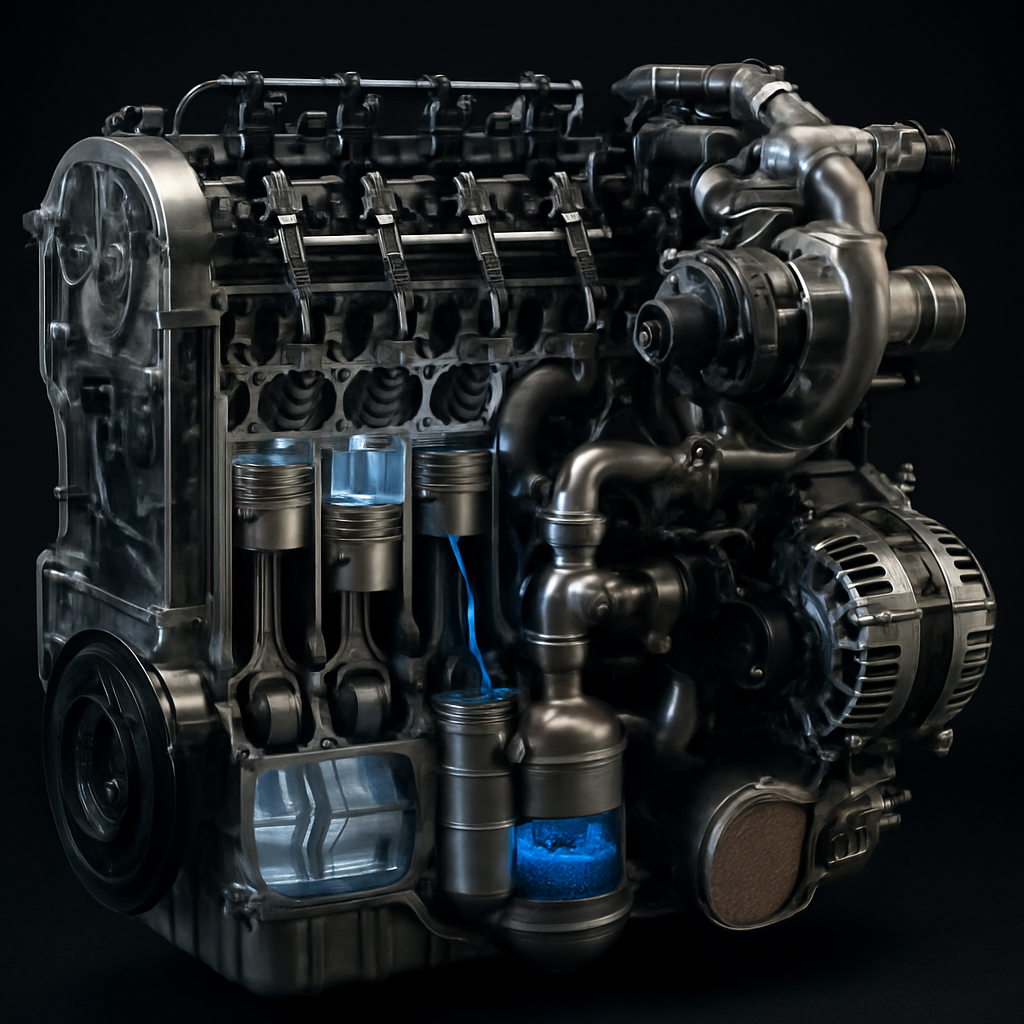
BlueHDi represents PSA’s response to stringent Euro 6 emissions legislation. The architecture combines a catalytic converter, DPF, and crucially, an SCR catalyst system requiring AdBlue (DEF – Diesel Exhaust Fluid) injection.
AdBlue, a 32.5% urea solution, is injected into the exhaust stream upstream of the SCR catalyst. At temperatures exceeding 300°C, this converts harmful nitrogen oxides into harmless nitrogen and water vapour. The system achieves up to 90% NOx reduction compared to earlier HDi variants.
Materials specification includes optimised piston coatings and revised fuel injectors capable of multiple injection events per combustion cycle. Pricing for BlueHDi engines starts around £2,500 for used units, climbing to £5,500+ for low-mileage examples.
Pros
- Meets Euro 6d emissions without performance compromise
- Accessing low emission zones unrestricted
- Refined operation with reduced noise
- Maintained fuel efficiency (55-70 mpg capability)
- Future-proofed against emission zone expansion
Cons
- AdBlue tank requires topping (typically every 6,000-12,000 miles)
- SCR system failures expensive (£800-£2,000)
- AdBlue crystallisation issues if neglected
- More complex diagnostics required
- Higher initial vehicle purchase price
Ideal drivers
BlueHDi suits environmentally conscious motorists and those regularly entering Ultra Low Emission Zones (ULEZ). Fleet operators benefit from compliance with current and anticipated legislation. The technology proves perfect for high-mileage drivers requiring Euro 6 certification whilst maintaining excellent economy. Anyone purchasing a diesel vehicle post-2015 should prioritise BlueHDi to ensure longevity of vehicle usability.
Compatibility considerations
Understanding fitment specifications proves critical when sourcing replacement components or considering engine swaps. HDi variants appeared across Peugeot 206, 207, 307, 308, 407, 508, Partner, and Expert models, plus Citroën C3, C4, C5, Berlingo, and Dispatch ranges from 1998-2013.
The e-HDi featured primarily in 2011-2015 models including Peugeot 208, 308, 508, 3008, and 5008, alongside Citroën C3, C4, DS3, DS4, and DS5 variants. BlueHDi technology equips virtually all PSA diesel vehicles from 2013 onwards, including latest 208, 2008, 308, 3008, 5008, Rifter models and Citroën equivalents.
Engine codes prove essential for parts ordering. Common HDi codes include DV4, DV6, DW10, and DW12. BlueHDi uses similar foundations but with ‘C’ suffix denoting SCR equipment (e.g., DV6C, DW10C). Always verify engine code against your vehicle identification number before purchasing components.
Installation requires specialist diagnostic equipment for injector coding and DPF parameters. The OBD2 diagnostics must be recalibrated following major component replacement. BlueHDi systems additionally need SCR catalyst learning procedures completed.
Model year considerations affect parts compatibility significantly. Pre-2004 HDi engines used different turbocharger configurations than post-2004 variants. Similarly, 2011+ e-HDi components won’t retrofit to earlier HDi motors without extensive electrical modifications.
Final verdict and buying recommendation
Choose HDi if you’re purchasing a pre-2013 vehicle for high-mileage motorway use where running costs matter most. Parts availability remains excellent, and mechanical simplicity aids DIY maintenance. Expect to budget £500-£800 annually for preventative maintenance including oil filter changes, fuel filter replacement, and DPF servicing.
Select e-HDi for mixed driving patterns where urban efficiency gains justify the modest complexity increase. The stop-start system delivers tangible savings in city environments whilst maintaining motorway capability. Annual running costs approximate £600-£900 including battery testing and system diagnostics.
Opt for BlueHDi when purchasing post-2015 vehicles, operating within emission zones, or requiring maximum future-proofing. The SCR system adds running costs (AdBlue averaging £6-£10 per 10-litre container), but emission compliance and refinement justify the premium. Budget £700-£1,100 yearly including AdBlue, additional emission system servicing, and standard maintenance.
For commercial operators exceeding 30,000 miles annually, all three technologies deliver exceptional value. Private buyers covering under 12,000 miles yearly should carefully consider whether modern diesel suits their usage pattern, as insufficient maintenance cycles cause premature DPF and injector failures.
Ultimately, BlueHDi represents the sensible choice for new purchases, ensuring compliance with evolving legislation. However, well-maintained HDi and e-HDi vehicles offer tremendous value on the used market for appropriate applications. Regardless of variant selected, ensure comprehensive service history verification and budget for emission system maintenance to maximise reliability.
What is the main difference between HDi and BlueHDi engines?
BlueHDi incorporates SCR technology with AdBlue injection to reduce NOx emissions by 90%, meeting Euro 6 standards. HDi engines lack this system, producing higher nitrogen oxide outputs whilst maintaining similar fuel efficiency and torque characteristics.
How often does BlueHDi require AdBlue refilling?
Consumption varies with driving style and engine load, typically ranging from 6,000 to 12,000 miles per tank. Most BlueHDi vehicles feature 15-17 litre AdBlue reservoirs. Warning lights illuminate approximately 1,500 miles before depletion, preventing engine restart if completely empty.
Can I disable the e-HDi stop-start system permanently?
The system can be temporarily deactivated via dashboard button each journey, but permanent electronic disabling isn’t recommended. This may affect warranty coverage and increase fuel consumption by 10-15% in urban environments. The AGM battery requires the system active for proper charging cycles.
What causes DPF problems in HDi engines?
Insufficient regeneration cycles from predominantly short journeys below 15 minutes cause soot accumulation. Exhaust temperatures must exceed 600°C for passive regeneration. Using incorrect low-ash oil specifications and ignoring warning lights accelerates blockage, potentially requiring £800-£1,500 replacement or professional cleaning.
Are BlueHDi engines more reliable than earlier HDi variants?
BlueHDi maintains mechanical robustness of HDi foundations whilst adding SCR complexity. Reliability proves comparable when properly maintained, though additional emission components introduce further potential failure points. Adhering to manufacturer service schedules and using quality engine oil ensures longevity across all variants.